Compost is the key to growing nearly any plant imaginable, and making your own couldn’t be easier!
Check out all of our articles below how to make and use compost all over your landscape:
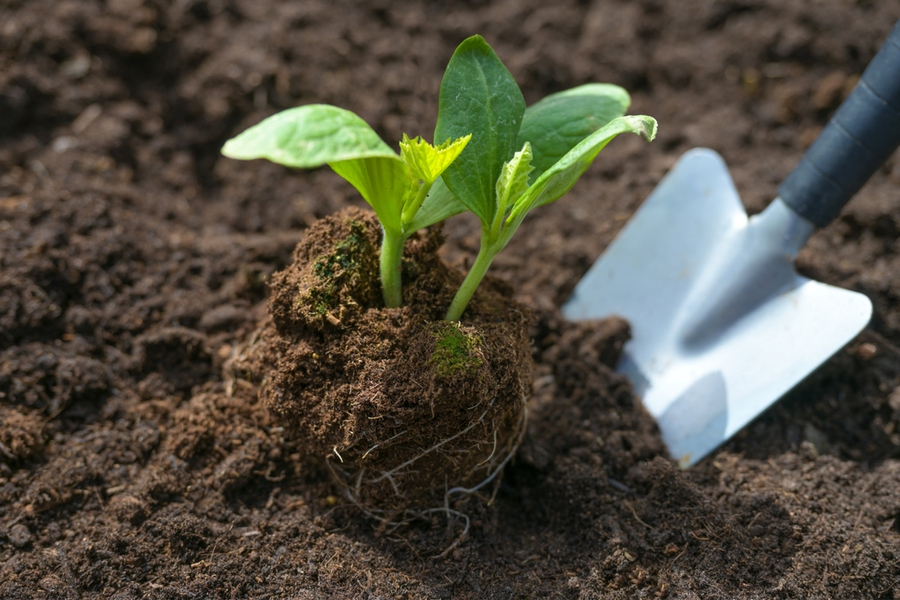
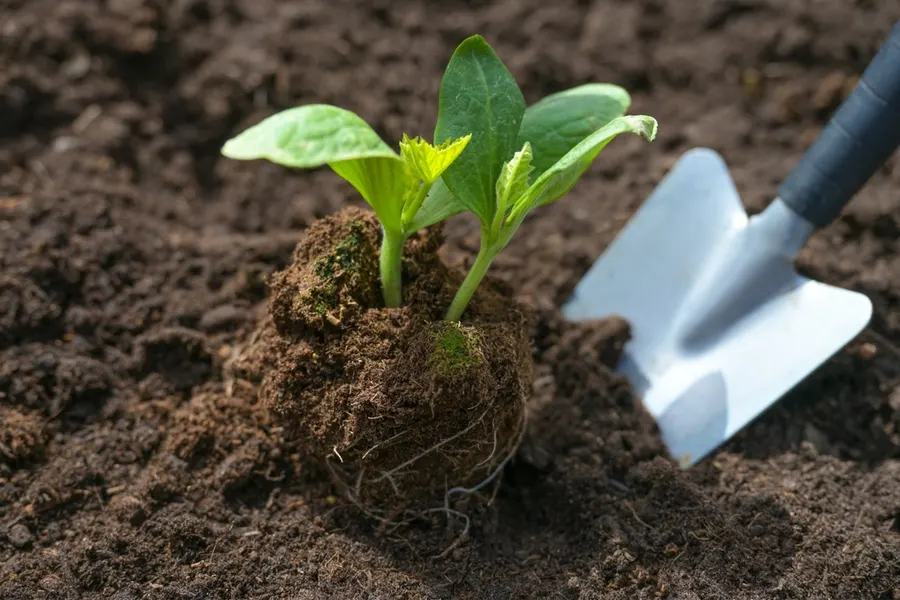
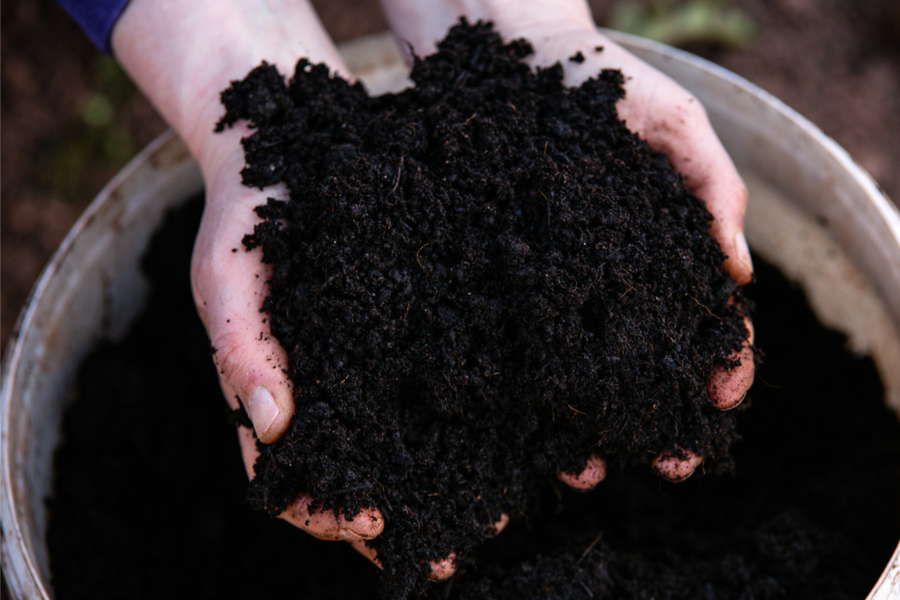
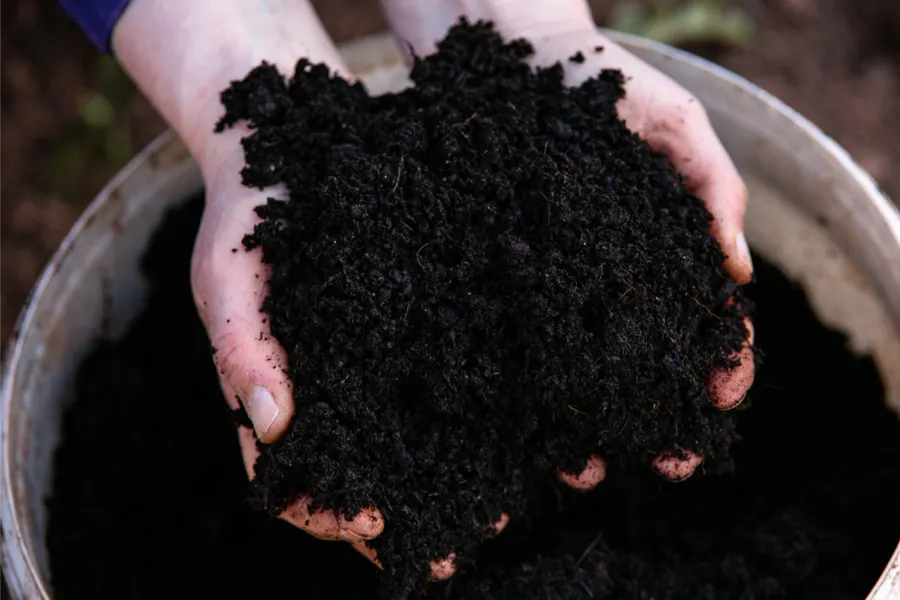


Compost is the key to growing nearly any plant imaginable, and making your own couldn’t be easier!
Check out all of our articles below how to make and use compost all over your landscape:
Looking for a few tips, tricks and secrets to turn all of those falling leaves into great compost this fall – and do it faster than ever?
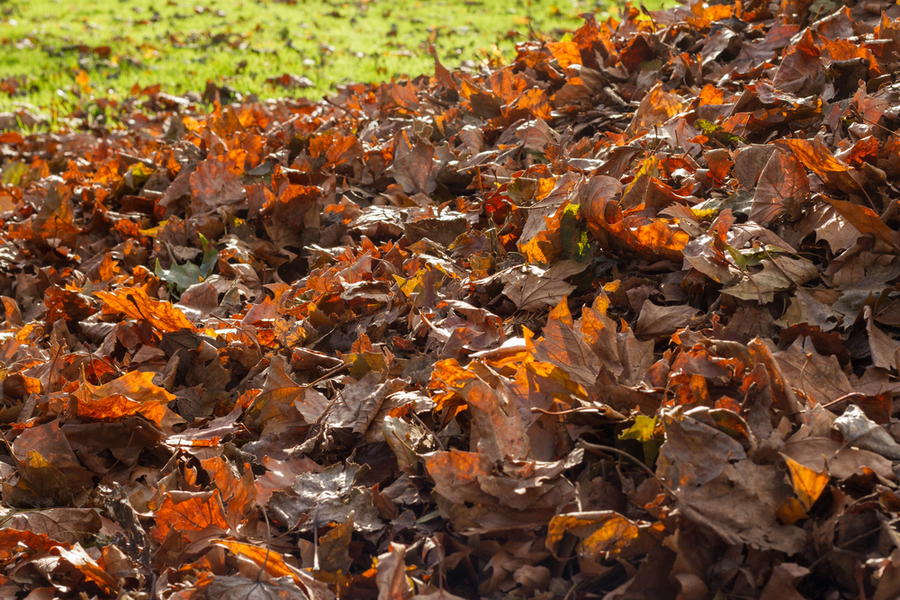
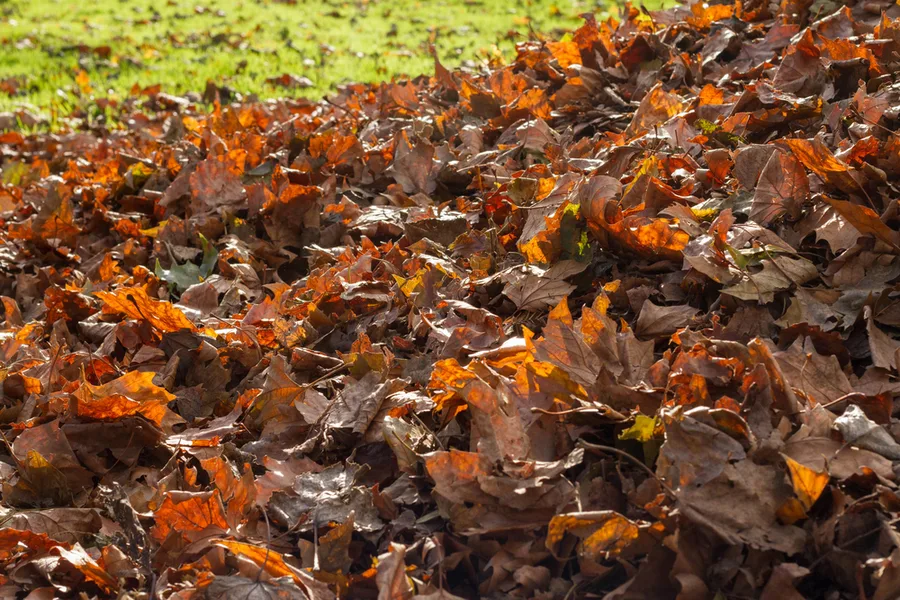
Autumn is here and that means the leaves are starting to fly off the trees and pile up everywhere. Although for many fall is the season of endless leaf raking, blowing and bagging, all of that work can pay off. Especially when you turn all of those leaves into incredible compost for next year’s garden and flowerbeds!
Composting your leaves is a great way to clean up the yard and create an abundance of amazing compost. Which, of course, can help power your vegetable plants and flowers to be more productive and healthier than ever.
Let’s face it, when it comes to recharging and building soil naturally, it’s hard to beat the power of compost. Working in large amounts of compost to your flowerbeds and garden keeps soil fertile and productive. As does using it when planting annuals, perennials and shrubs, trees and bushes.
For many gardeners, it can often be a struggle finding enough materials to make the large amounts of compost they need. But that is exactly where leaves can save the day. Not only is there an overabundance of leaves in the fall – when composted correctly, they can be turned into loads of finished compost by early spring. Which, of course, is just in time for planting season!
The good news is that creating a fast working compost pile isn’t difficult or complicated. In fact, by following the few simple tried and true tricks below, you can easily have your pile cooking away in no time at all – and turn those leaves into great compost you can use next spring!
The first rule of making fast compost from leaves is to only include leaves that break down quickly. It’s also important at the same time to make sure the variety of leaves won’t harm your plants.
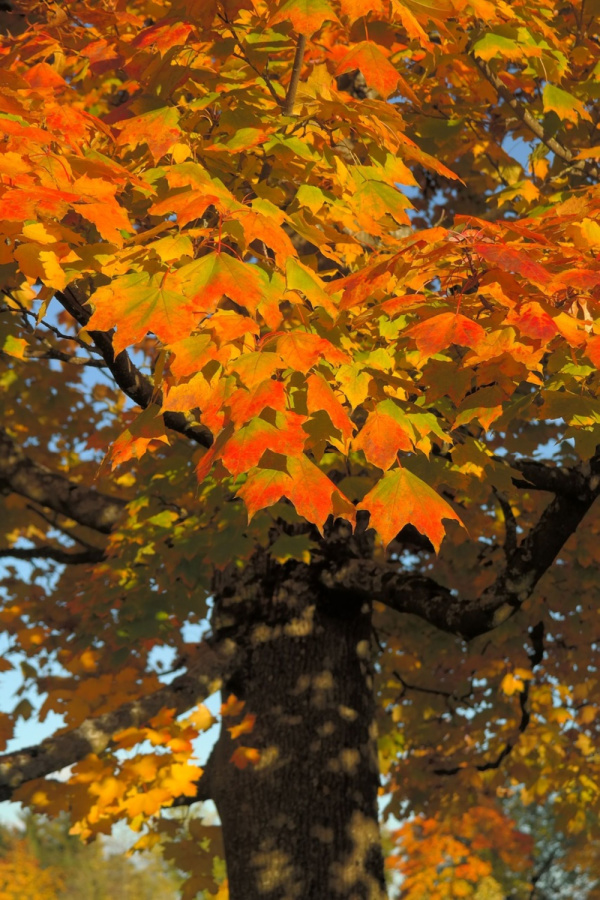
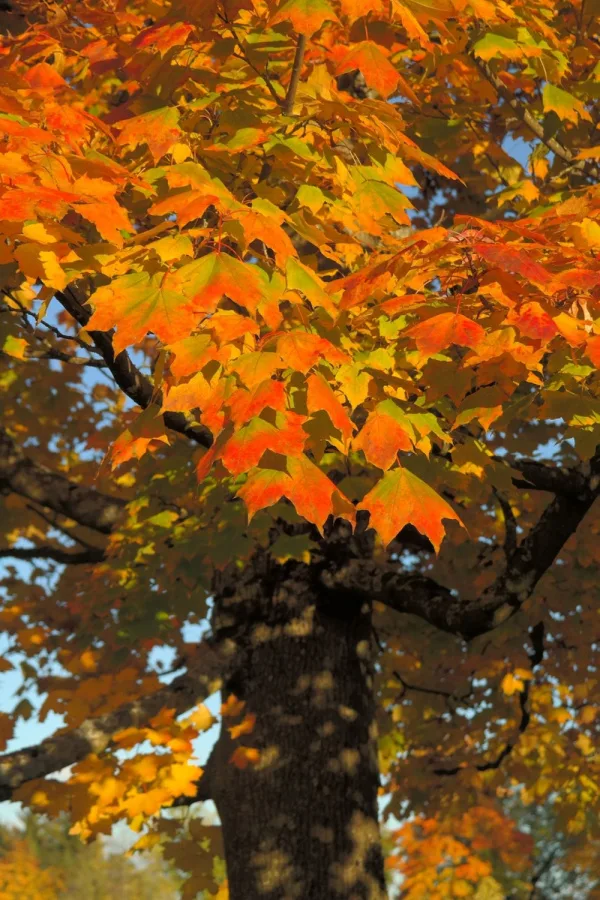
Although you can compost all types of leaves, there are some varieties that are harder to compost than others. These are best left out of fall compost piles because they can slow the decomposition process down and leave you waiting years for finished compost instead of months.
Leaves from trees that produce waxy leaves such as magnolia and ginkgo trees are among the hardest to compost. Their protective, shiny coatings can take years to break down. It is also best to leave pine needles out of a leaf compost pile. Again, their coating simply takes too long to break down.
You can still use magnolia, ginkgo leaves and pine needles as a great mulch. But these hard to break down materials are simply not helpful for fast composting. Especially if you are looking to have a pile ready to use next spring or summer. See: How To Use Pine Needles In Gardens & Flowerbeds – And Where Not To!
In addition to leaves that break down slowly, there are also a few tree varieties whose leaves can be harmful to plants when turned into compost. Black walnut, eucalyptus, beech and buckeye trees all fall into this category. All contain various toxins and substances that can either kill or harm plants.
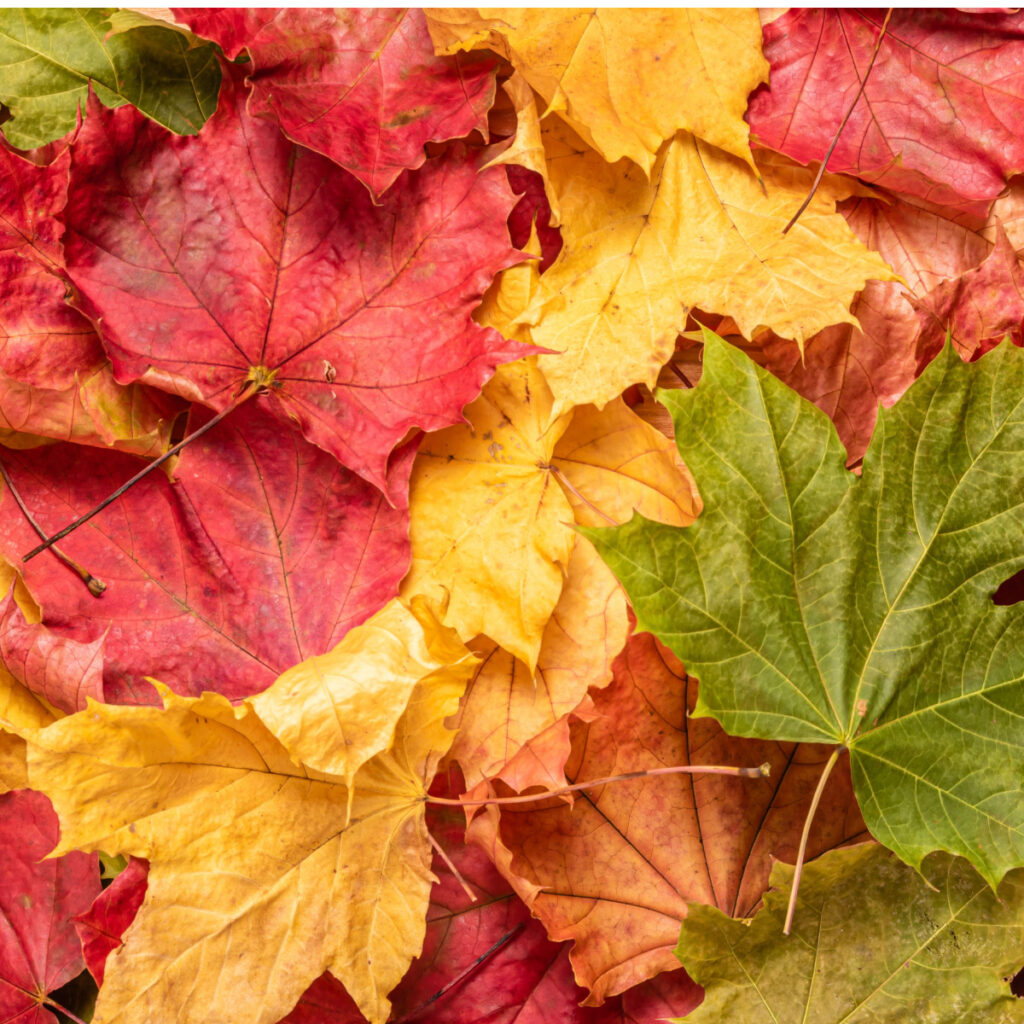
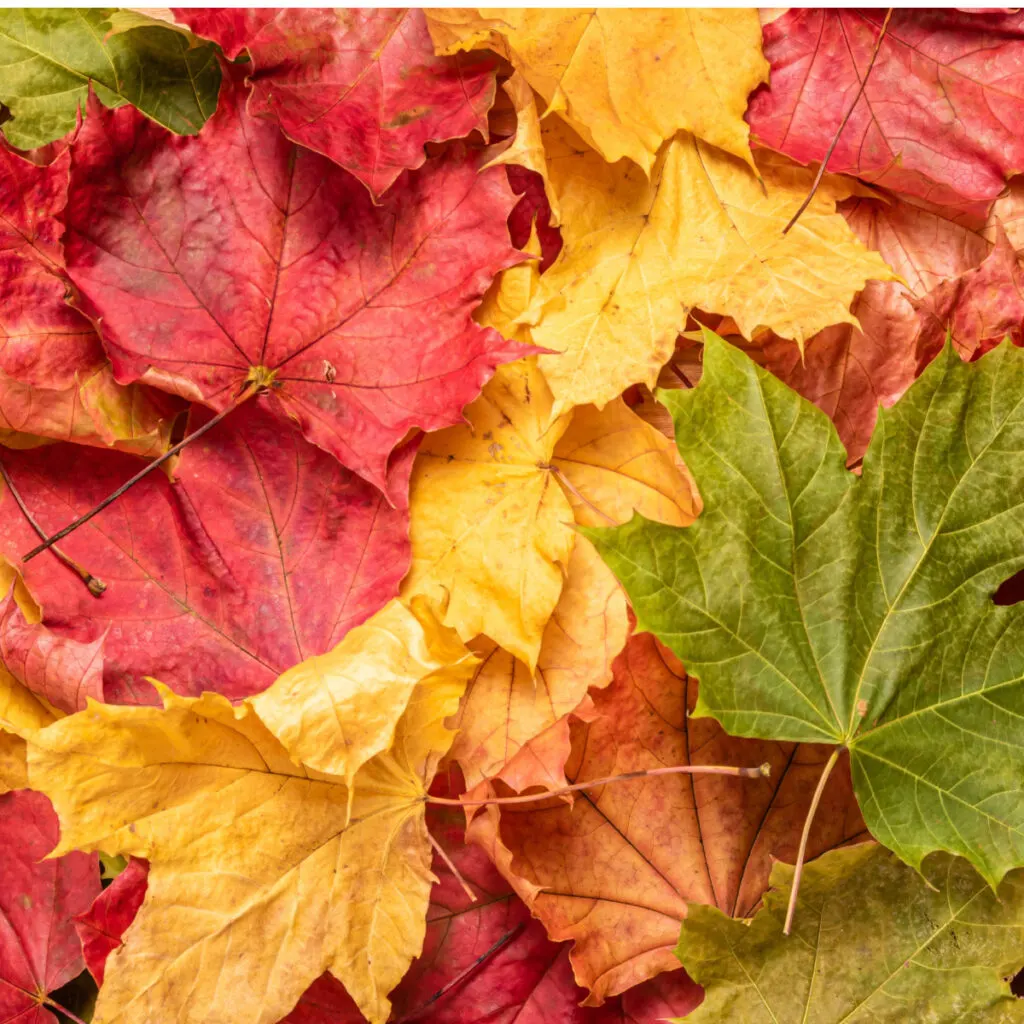
So what are the best leaves to use? Fruit trees, maple trees, and other soft-leaf producing trees such as ash and birch top the list. Poplar, willow, cherry, black cherry and elm trees are also good. Oak leaves can be use for composting too, but due to their acidity, should never make up more than a third of the pile.
All of the leaves above are not only full of nutrients, they also happen to break down quickly in a compost pile. Especially, as you will see with tip number two below, you shred them first!


If you want to make compost fast with leaves, it all starts with shredding them before building your pile. Chopping up leaves speeds up the decomposition process immensely – and saves on space as well. Whole leaves can take years to break down. And when wet, they create a moldy, smelly and very unsightly compost pile.
The good news is that shredding doesn’t have to be difficult or time consuming. Nor do you have to have fancy equipment. Sure, a leaf shredder or chipper works wonders, but there are other tools that are usually on hand that can do the job just as fast.
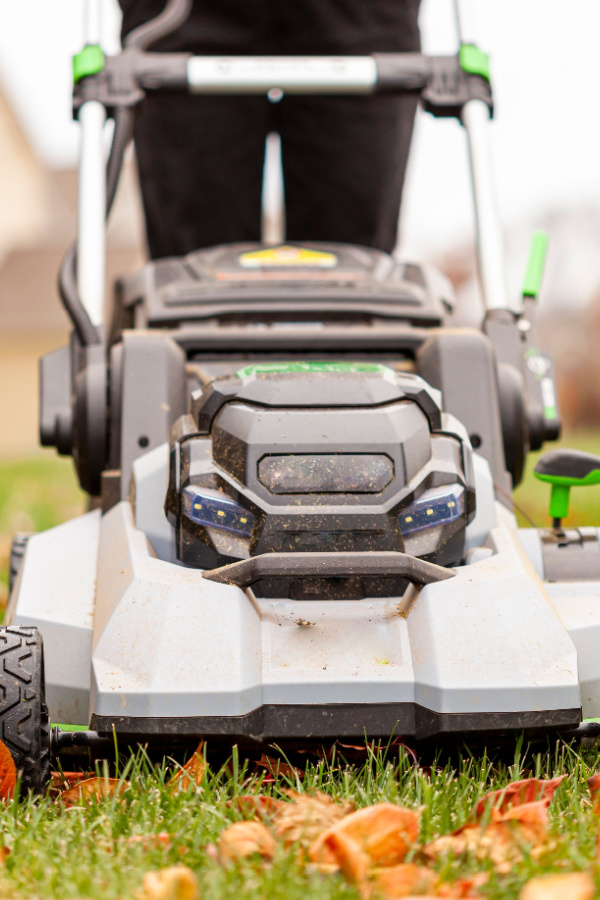
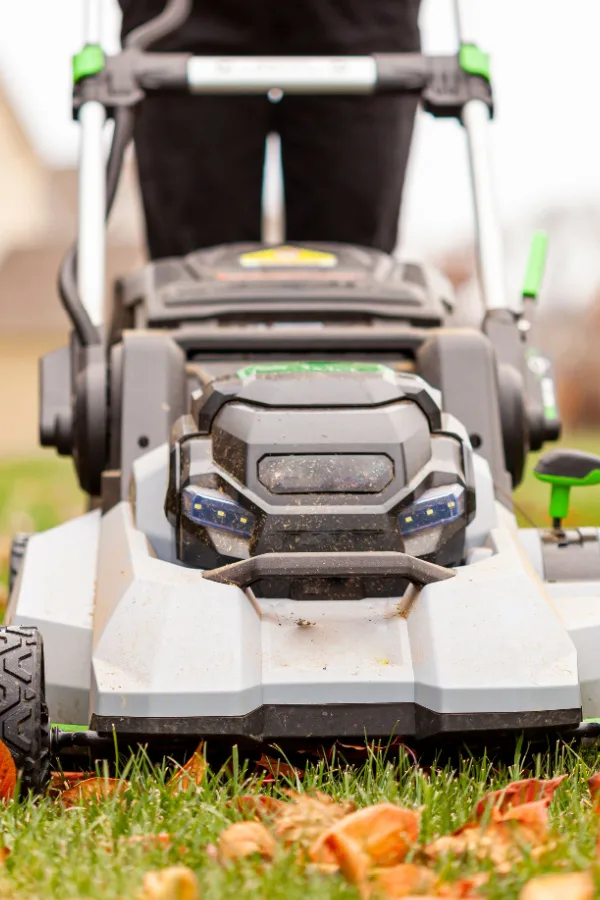
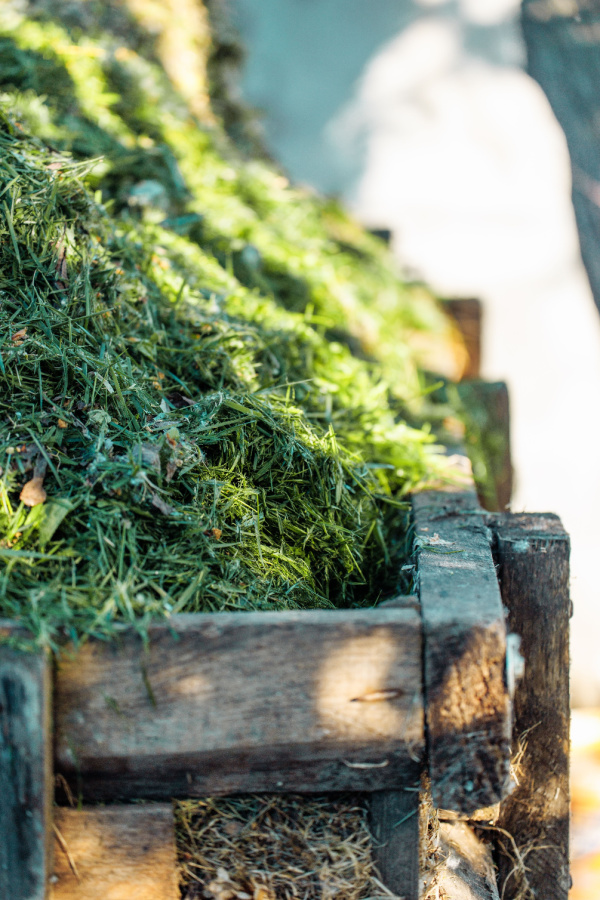
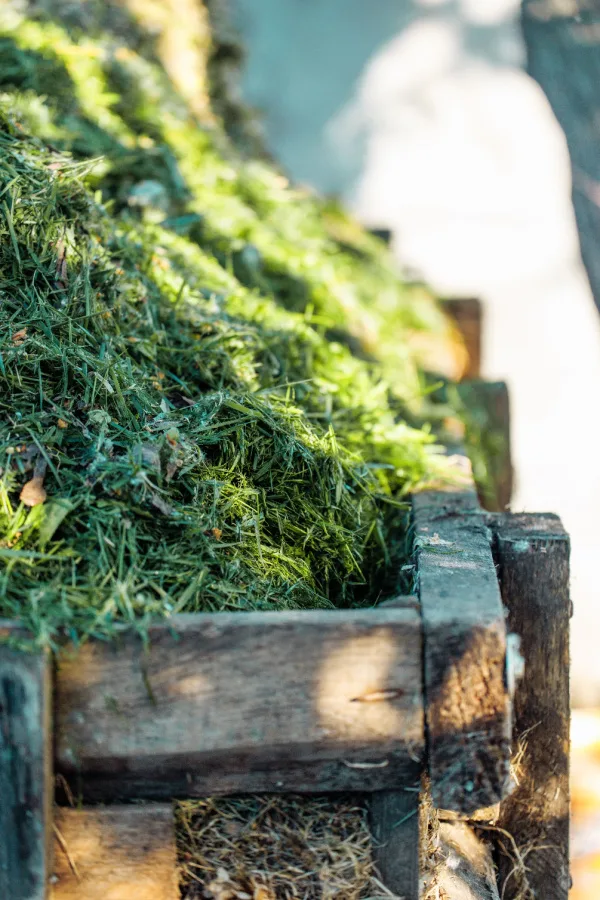
In fact, the easiest and fastest way to shred leaves into fine pieces is with a lawn mower. A few passes with a riding or push mower and your leaves will be perfect for composting. If you happen to have a bagging attachment on your push mower, it makes collecting even easier.
Once you have your pile of shredded leaves, it’s time to heat them up to get them decaying. Although large piles of shredded leaves will decompose slowly over time by themselves, by adding additional “hot ingredients” to your pile, you can speed up the process and create your own version of black gold.
A great compost pile is made up of a blend of dry and green materials. The shredded leaves (a dry material), need to be blended with enough green to activate the pile.
Green materials are the main source of nitrogen to the pile. And nitrogen is the crucial element needed to start the process of rapid decomposition. A good rule of thumb for a fast-acting pile is to add one part green for every four parts dry.
In simple terms, that means if you add in four large bags of shredded leaves, add in the equivalent of a large bag of green material. Good “greens” for your pile include coffee grounds, potato peels, vegetable scraps, and green grass clippings.
Also included in the green family is manure from animals like chickens, rabbits, cow or horse. (Do not use pet manure as they can easily transmit disease)
When making a fall leaf composting pile, try to add as many greens to the pile as you can early on. The faster you get the balance of green to brown right, the faster it will break down. You can also continue adding greens to the pile during the fall season. When you do, simply turn them into the center of the pileto help add even more heat and speed decomposition.
As for the size of your leaf compost pile – keep it at least 3′ high x 3′ wide x 3′ deep. This will be big enough to generate internal heat, but not too large to manage. Open garden spaces are great places to locate a pile during the fall and winter months – and you don’t even need to add sides to contain it!
Once created, a compost pile needs oxygen and water to thrive. And the only way to provide it is by turning and watering the pile as needed on a regular basis.
Turning allows oxygen to enter the center of the pile. By turning your pile at least a few times each week, you can keep oxygen present in the middle, which keeps the decomposition process going strong. If you can turn daily, even better. The more you turn, the more it will heat up and stay hot.
In addition to oxygen, your compost pile also needs moisture to keep cooking. A working compost pile should be moist, but not saturated. The best comparison is that it should feel like a well-wrung wet sponge.
If your pile begins to dry out in the center, adding a bit of water when turning will help keep it active. Continue turning until the pile freezes over in the winter – and then start turning again in the early spring as it warms up. By planting time – your leaf compost will be more than ready to go! For even more tips on how to put all of those fallen leaves to great use, see: The Best Ways To Use Leaves In Gardens & Flowerbeds – 5 Great Ways To Use Fall Leaves!
Follow Our Facebook Page For Great Gardening Tips And Advice! This Is My Garden Facebook Page
This Is My Garden is a garden website created by gardeners, for gardeners. Jim and Mary Competti have been writing gardening, DIY and recipe articles and books and speaking for over 15 years from their 46 acre Ohio farm. They publish three articles every week, 52 weeks a year. Sign up today to follow via email, or follow along!
Want to know if it is possible to compost weeds in your home compost pile? One thing is for sure, the topic always brings up a lot of questions and debate among gardeners!
On one side, some gardeners will tell you that placing weeds in a compost pile is simply asking for trouble. By doing so, you risk having your finished compost turn into a planting medium for seeds wherever you use it.
On the other side of the argument are gardeners who feel that the nutrients in weeds can be extremely beneficial to home compost piles. Not only can they help you create more compost for free, but the compost will be more balanced with the added power they bring to a compost pile.
One thing is for sure, all gardeners can agree that creating and using compost can pay off big for the health and growth of trees, plants, flowers and vegetables. Not only is compost packed full of nutrients, but all that organic matter helps to improve the soil composition on your property.
So which side of the debate is correct when it comes to composting weeds? As it turns out – it really all depends on how and what part of the weeds you compost!
Composting is a great way to recycle and reuse organic products from your home and property. From dry fallen leaves to shredded cardboard, crushed eggshells and more, all of these materials help to create a product that is like no other.
The finished result of all these materials breaking down and decomposing is a supercharged soil amendment that you can use to improve and power the plants and trees around your home. (They don’t call it “black gold” for nothing!)
Not only is the compost good for your soil, but it’s good for your environment as well. You can reduce the amount of trash that winds up in local landfills when you choose to compost instead. It truly is a win-win!
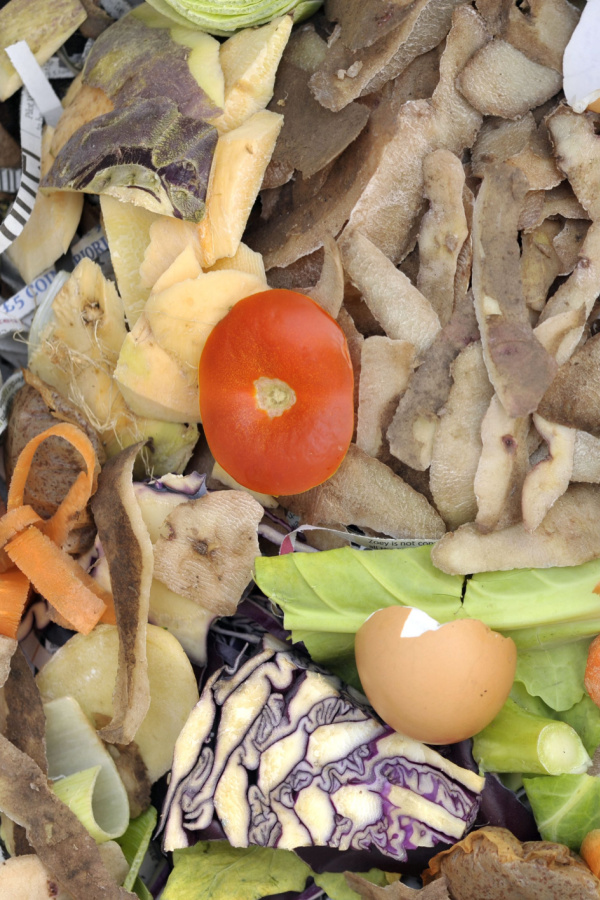
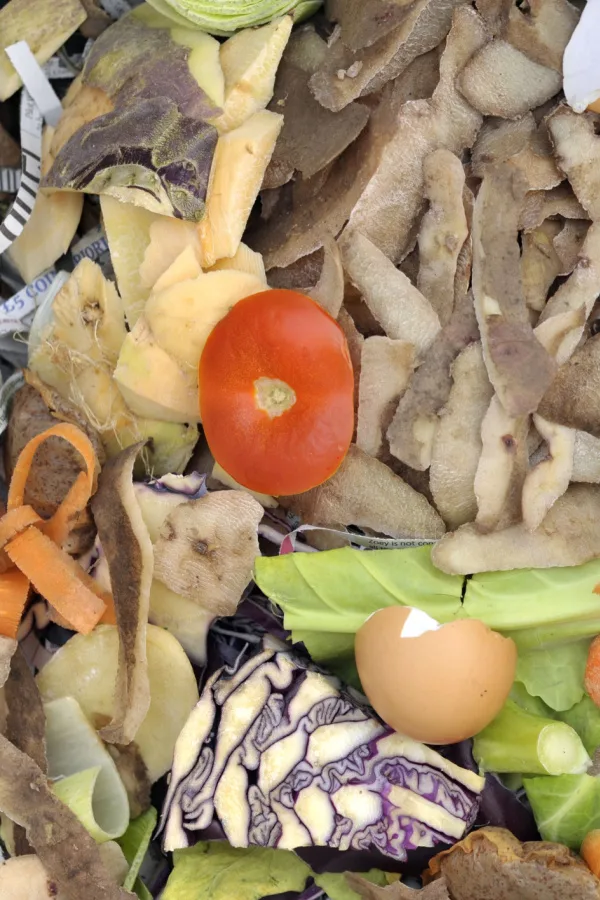
You can compost on a large-scale level where you have multiple 3-foot by 3-foot bins. Or, you can compost on a small scale level by only filling a couple of 5-gallon buckets with compostable products. Each method is great a way to improve your soil while reducing your amount of trash at the same time! And yes, that can include composting weeds safely when done correctly!
The first step in this debate is understanding what a weed really is. Technically speaking, a “weed” is a plant that is unwanted and competing for plants that are cultivated. But when it comes to plants and gardening, it’s important to realize that the term might be different for two different people.
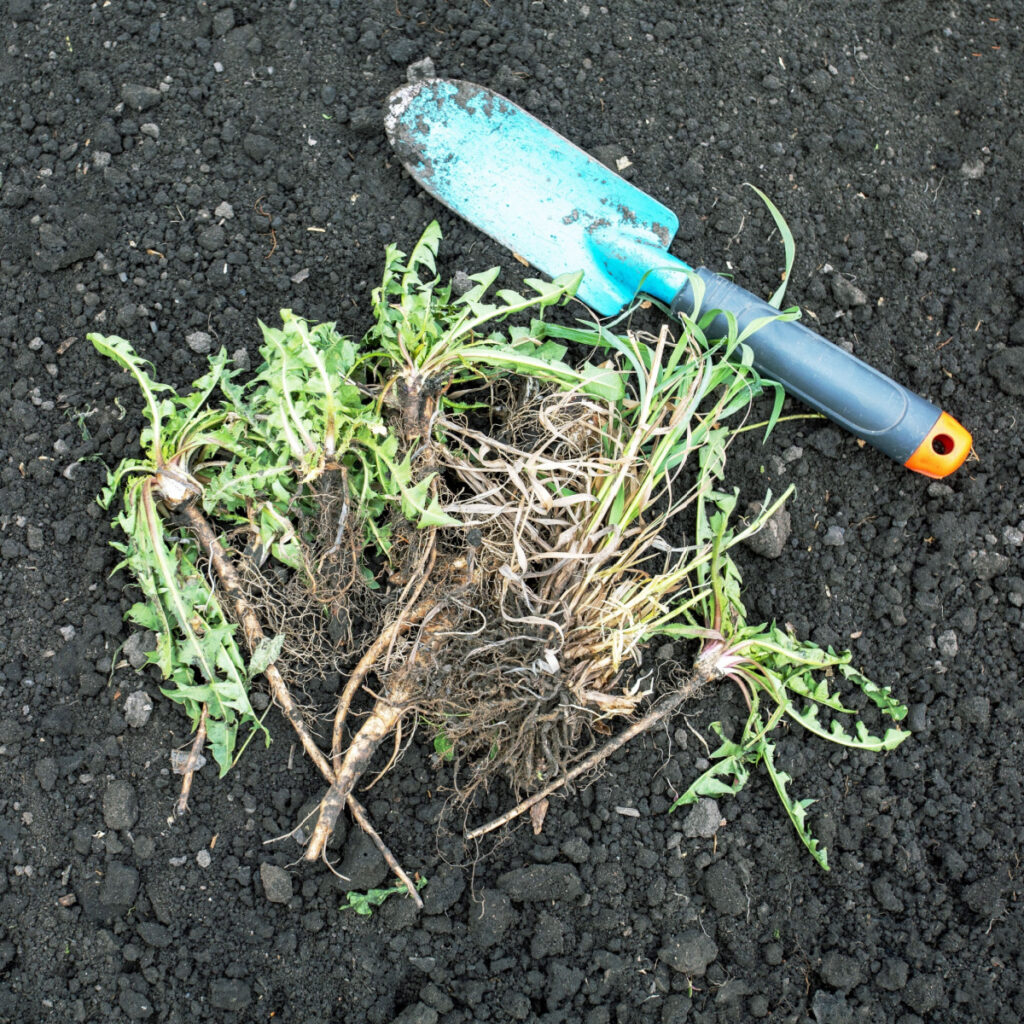
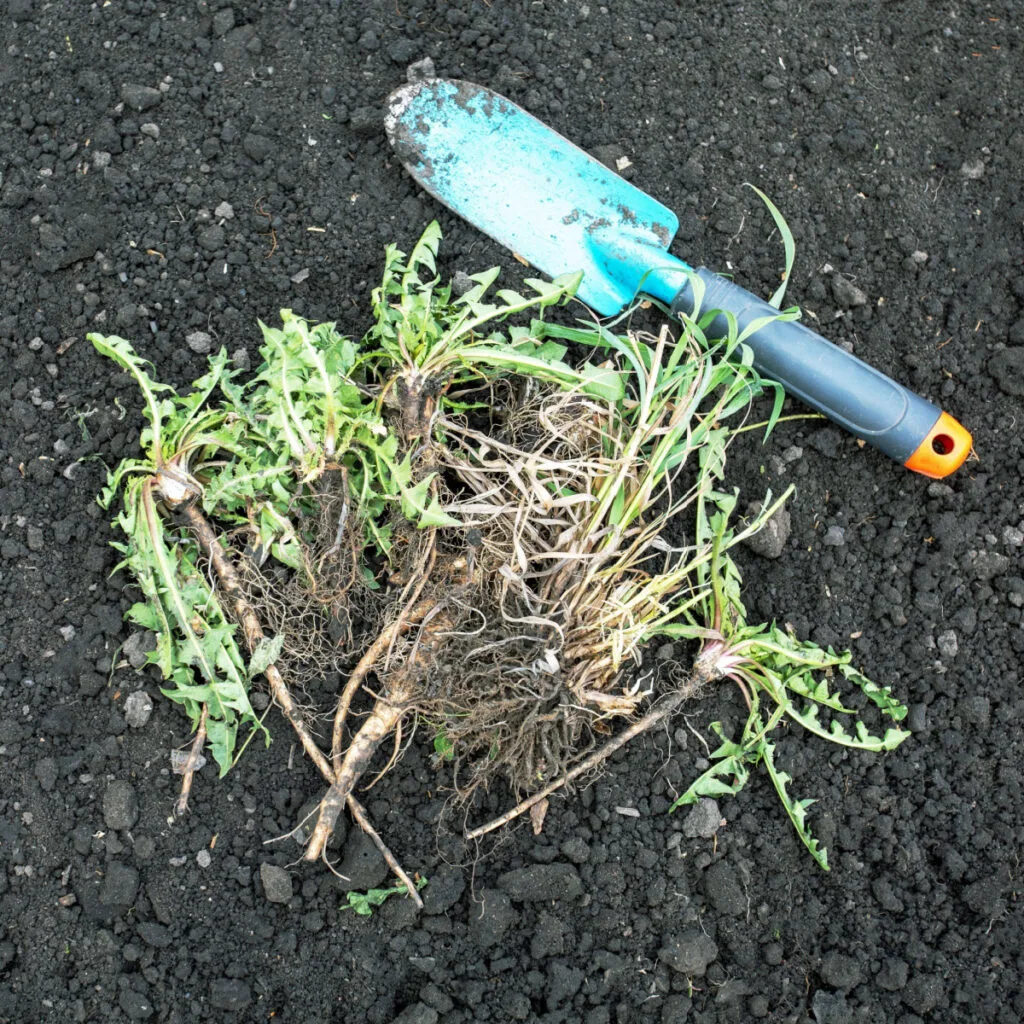
For example, some people consider dandelions to be a weed and a huge nuisance. They fill your beautiful lush green grass with bright yellow blooms that eventually turn into little white puffballs. And don’t forget how they seem to grow 10 inches the day after you mow your yard!
But to others, dandelions are an excellent pollinator plant, helping to attract bees, butterflies, and more. In addition, some people even use dandelion for food as well. You can make everything from dandelion jelly to sauteed dandelion greens and wine from this “weed.”
So does that mean dandelions can go into the compost pile and benefit the compost? Or will they be more of a pain if they are added to the pile? And the same question applies to clover as well!
Many homeowners trying to keep an immaculate turf lawn would consider clover to be a weed. But clover can also be beneficial on so many levels.
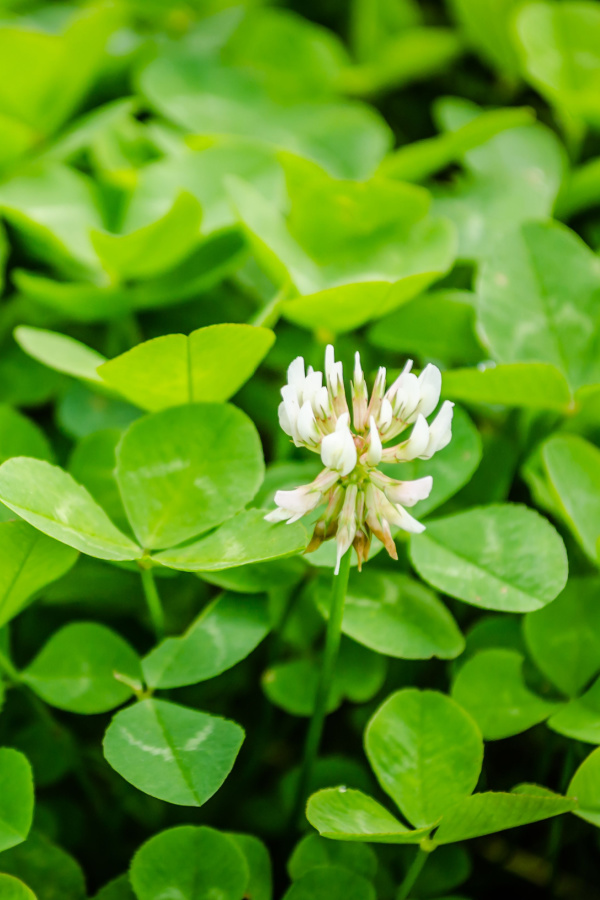
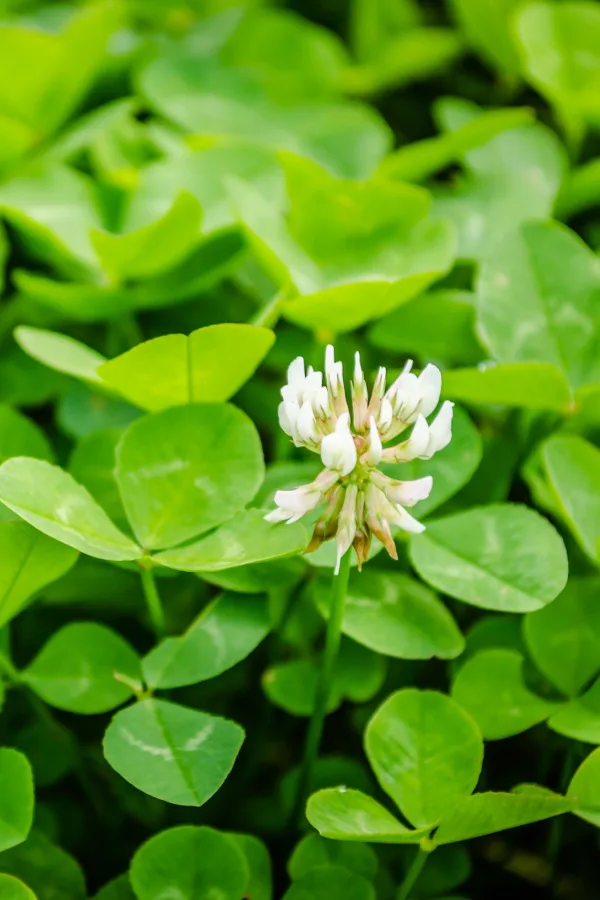
Not only does it feed important pollinators like bees, but it also helps to fix the nitrogen levels in the soil, allowing other plants around it to grow better. In fact, it works so well in providing nutrients that many gardeners use it as a cover crop! (See, “How To Plant A Green Manure Crop”)
The point is that all green living plants are teeming with nutrients and can be beneficial in their own ways. And because of that, weeds can be extremely valuable as they decompose in a compost pile – just the way a non-weed plant can be. That is, of course, as long as you are using a bit of caution when adding them to your home compost pile!
Even though weeds are a great addition to a compost pile by helping to add nutrients and organic matter, there are a few risks you take when including them. You can reduce those risks by taking two simple steps prior to adding them to your pile.
As with any plant material going into your home compost pile (i.e., flowers, vegetables, fruit, etc.), always be sure to remove any seeds prior to adding them to your pile. This includes the seeds within the fruit or vegetables – or the flower heads themselves.
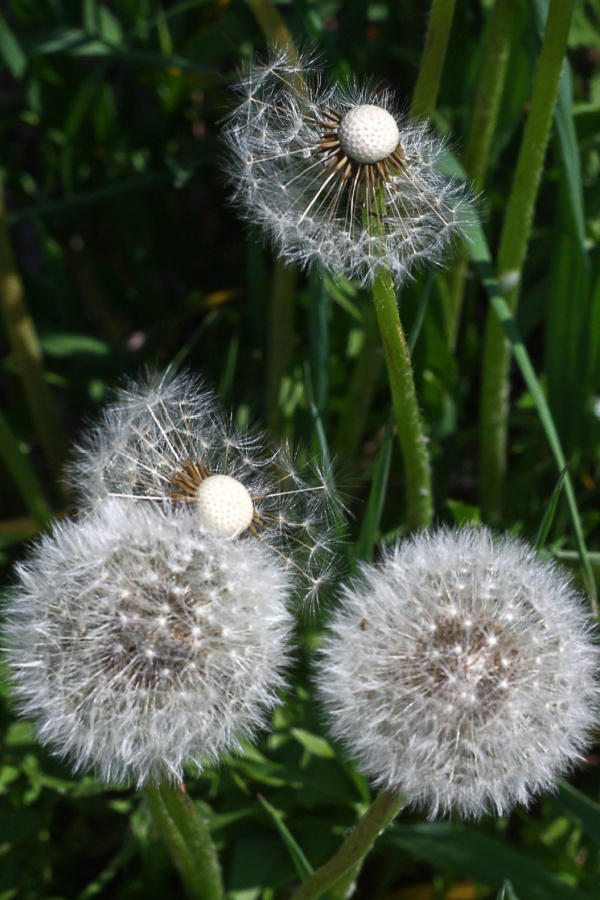
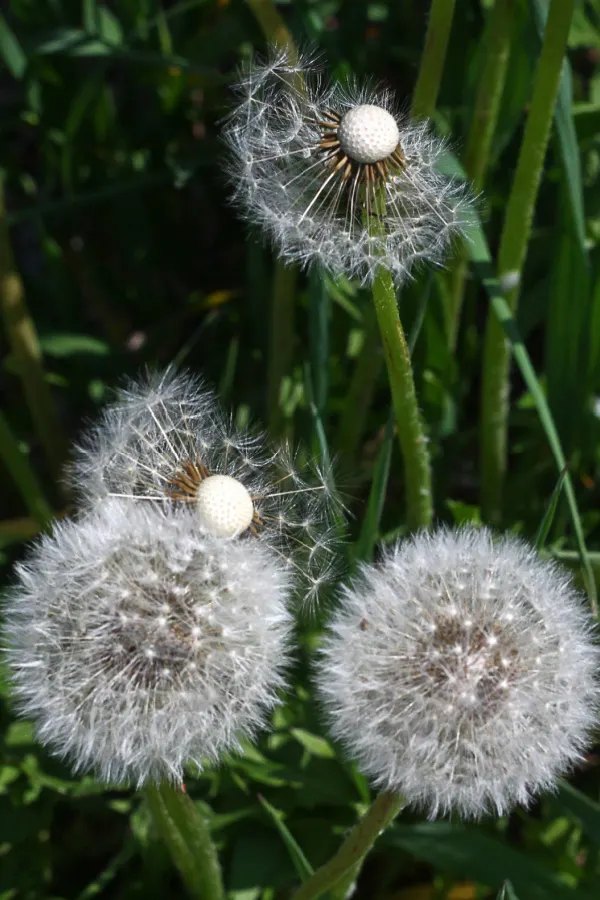
Unfortunately, most home compost piles just don’t heat up to high enough levels to kill the seeds from plants. And because of that, the seeds can easily hang out only to be carried and sprouted wherever you go to use your fresh compost.
In addition to keeping the seed heads out, you should also avoid plants that reproduce from their roots. A great example of this would be the Canadian thistle.
Canadian thistle can be a nightmare to eradicate from flowerbeds and gardens. Its long, tenacious roots can produce hundreds of runners and buds to create a seemingly endless supply of new plants. These roots might not break down well enough in compost piles, allowing them to regenerate once the compost has been used around your property.
But beyond these few precautions, there is little worry about adding “weeds” to your compost pile. Not only is it a great way to create more compost for free, but it finally gives all of those weeds a purpose in your landscape!
Follow Our Facebook Page For Great Gardening Tips And Advice! This Is My Garden Facebook Page
This Is My Garden is a garden website created by gardeners, for gardeners. Jim and Mary Competti have been writing gardening, DIY and recipe articles and books and speaking for over 15 years from their 46 acre Ohio farm. They publish three articles every week, 52 weeks a year. Sign up today to follow via email, or follow along!
You might be surprised just how easy it can be to build your very own two bin compost system – and how fast it can help make a continuous supply of amazing compost for your garden and flowerbeds!
When it comes to powering your soil and plants, nothing beats compost. Compost contains the perfect blend of nutrients and organisms that can bring tired soil back to life. Those same nutrients can also absorb easily into the roots of plants to give them the power they need to thrive.
Compost is perfect for adding into spring planting holes for vegetables, flowers, herbs and more. It’s also great to use as a mulch around plants. As a mulch, it holds in moisture while leaching nutrients down into the soil. In addition, you can also make an incredibly powerful fertilizer tea – simply by soaking water in compost.
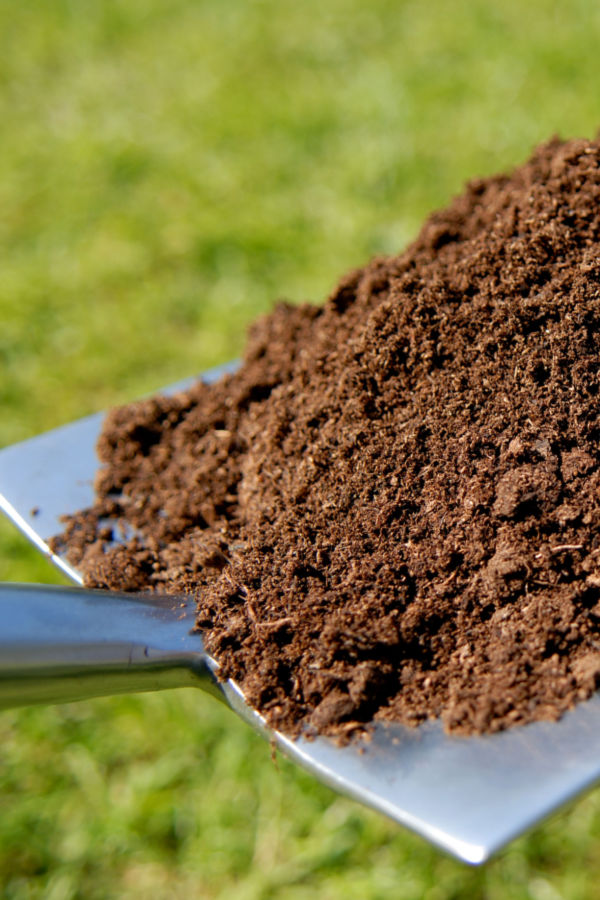
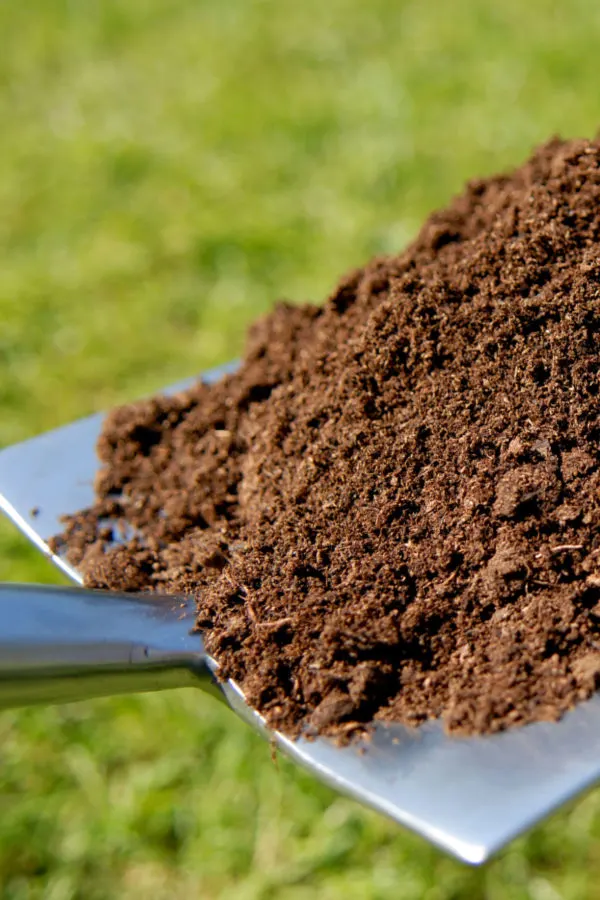
The only real issue with compost is that you can never seem to make or have enough on hand for an entire growing season. Even the best compost piles can take six to eight weeks to break down, and if you only have a single pile working, you can run out of compost quickly. And that is exactly where a two bin compost system can help save the day!
A two bin system allows you to instantly double the amount of compost you can make. No more waiting for a pile to finish before starting a new batch. Instead, with a two bin system, you can have your next batch already going.
The advantages of a two bin system go far beyond simply doubling the amount of compost. For starters, you can take out materials that are slow to decompose from a nearly finished pile and place them into the new batch. That allows you to use what is ready and start another pile even faster.
Even better, by placing a bit of nearly finished compost from one bin to a new pile in the other bin, you introduce the bacteria and organisms that are vital for breaking down materials fast. That means more compost for you to use quicker than ever! See: How To Make Compost Fast!
Perhaps best of all, having two bins allows you to collect twice the material! When all of those leaves fall, you have more space than ever to collect them. The same goes for grass clippings or when you cut back plants. Unfortunately, all too often, with a single bin, you only have room for a portion of the materials available.
Creating your own two bin composter is actually a simple process. In fact, armed with a few basic tools and some untreated 2x lumber, you can fashion together a beautiful 2 bin system in just a few hours.
There are a few things that are very important to know when creating any compost bin. For starters, the size of each bin needs to be able to hold at least 3 cubic feet of material. In fact, 3′ x 3 ‘x 3’ is the perfect size for a single compost pile.
Unfortunately, smaller piles cannot keep their heat. As they cool off, it slows decomposition, extending the time frame needed for finished compost. Bigger piles can certainly hold heat, but they can be extremely hard to work and turn, not to mention find the space for!
With that in mind, creating a double bin system with two individual 3′ x 3′ x 3′ bins side by side is ideal. It allows for plenty of size for each working pile – and easy access to both.
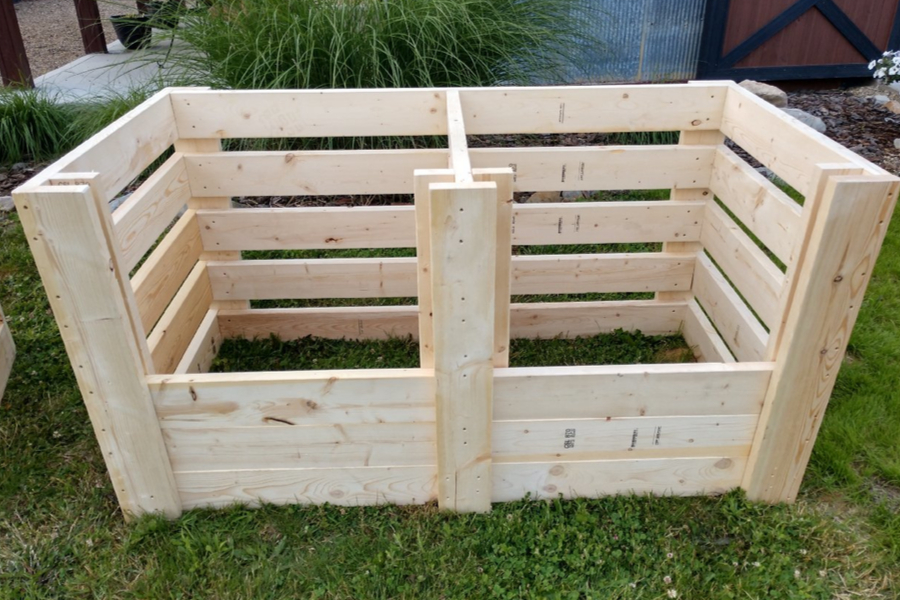
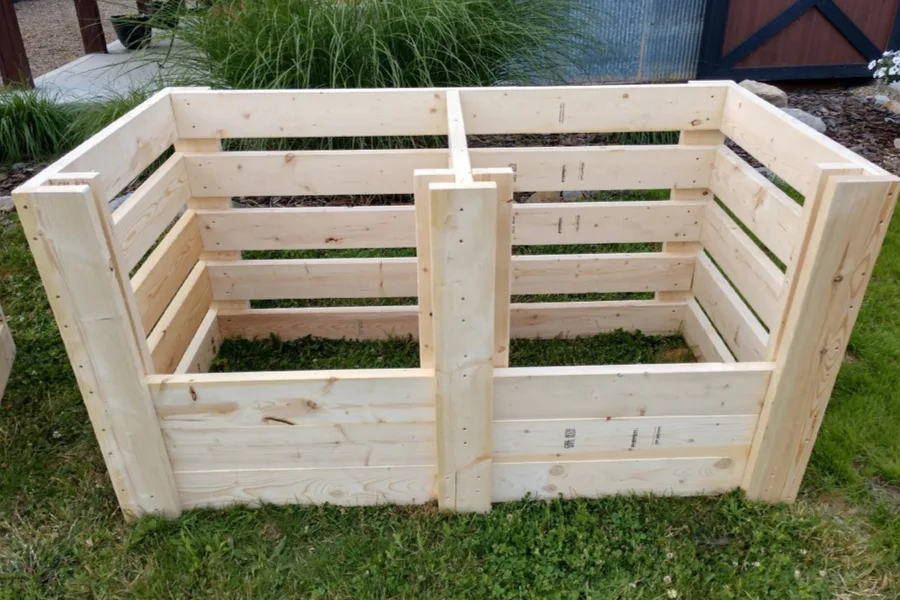
Ordinary 2x framing lumber is perfect for building compost bins. And yes, it is important to use untreated wood for your bins. Treated lumber contains a long list of chemicals. Chemicals that can leach into your compost and be quite harmful for your plants and you.
Untreated framing lumber actually holds up extremely well. And, you can paint or stain the outside (compost will not come in contact with outside edges) to help keep it looking good.
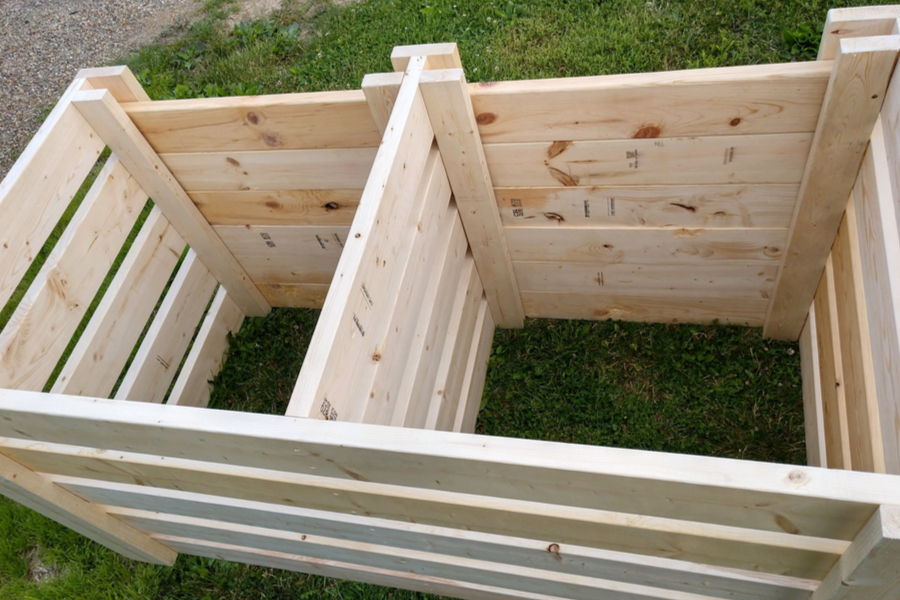
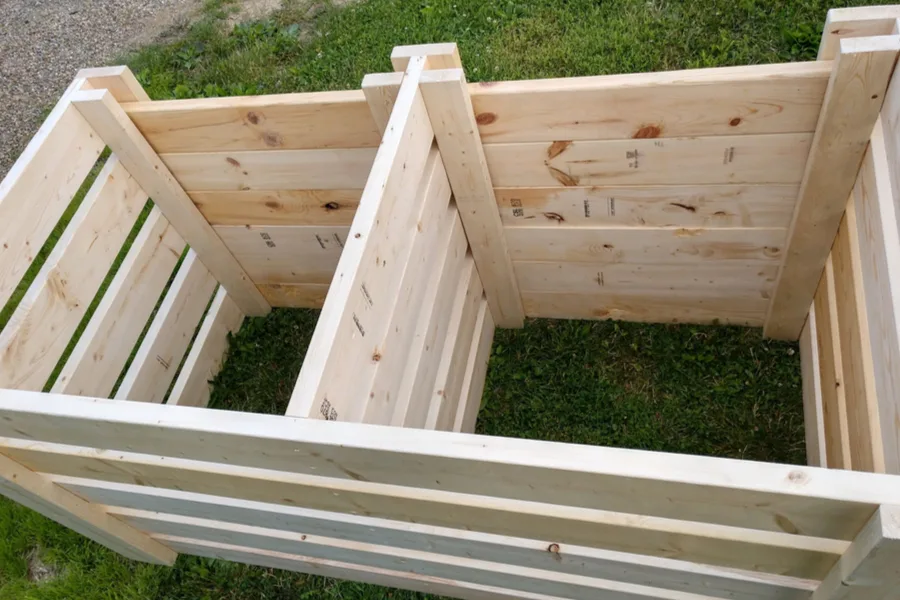
We do have complete step by step building plans for the double compost bin pictured below in our Etsy shop. All of our step by step plans are instant download pdf’s, and for $10, include a full material list, cut list and step by step instructions with photos all along the way. See: Double Compost Bin Plans
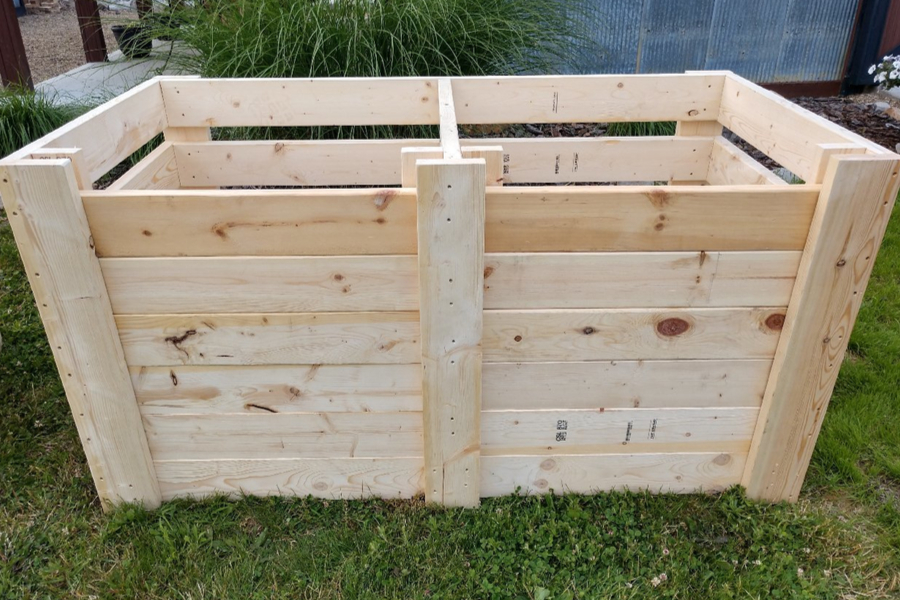
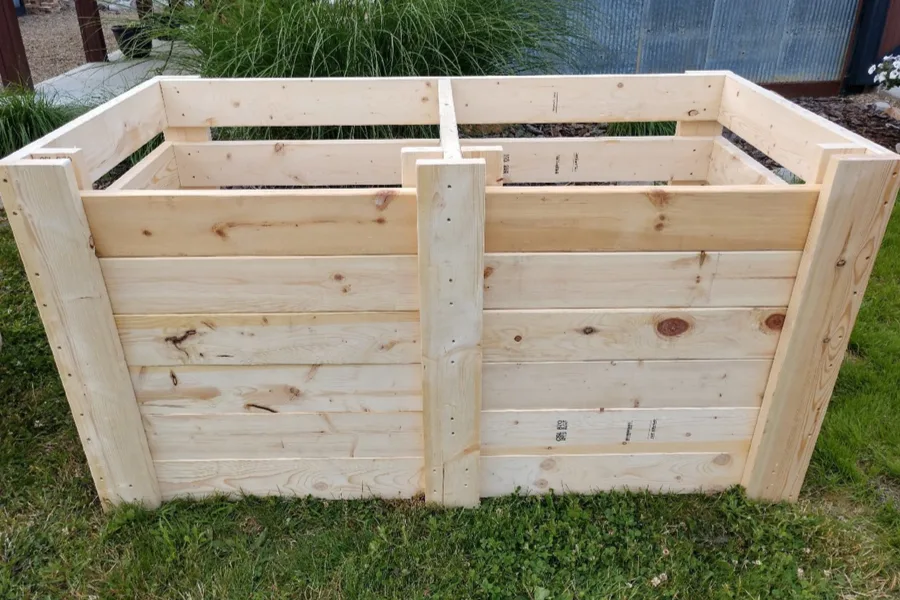
The bin highlighted below features slat spaces on the sides and back to allow for good air flow to the pile. The front section has removable wood slats that can slide in and out as needed to work the pile. This is great for keeping the pile out of sight when not working it.
The double compost bin requires (11) 2 x 6 x 12’s and (1) 2 x 4 x 12′ board to complete. The 2 x 6 x 12’s are easy to cut down to the main front 6′ sections and smaller 3′ side sections. Again, using 2x lumber is a must for durability – unfortunately, 3/4 inch and even 1 inch thick boards will warp and rot too quickly.
It is best top use screws when assembling any wood bin. Not only does it make fast work of assembly, the screws will hold the boards tighter whereas nails will usually work their way out over time.
As for tools, you will need some type of saw to cut straight boards. A chop saw, circular saw or even a hand saw will work. In addition, a power screw driver/drill and 1/8th inch drill bit for pre-drilling screw holes is all you will need.
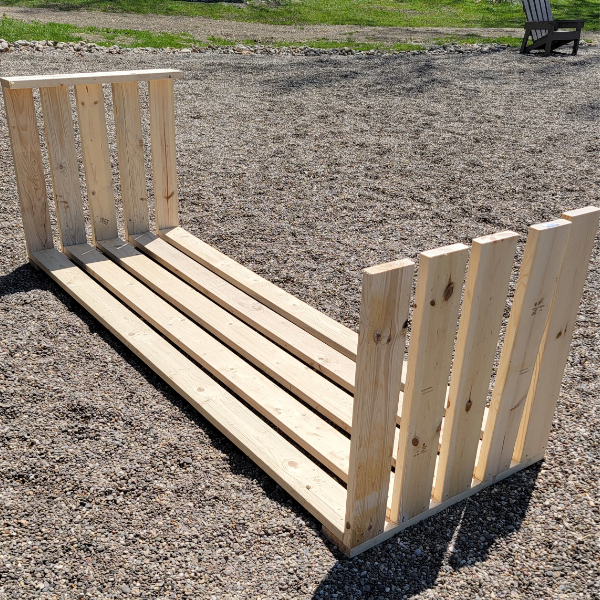
Not only does the compost bin go together easily, it looks great anywhere! The 3′ sides and 6′ back are assembled as a “U”, and then a simple middle section separates the two bins in to (2) 3′ sections. A 2 x 4 is then used on each front side to create a channel for the front slat boards to slide in.
It is an open top composting bin system, which is great for easy access and air flow. It is quite simple to create a lid or cover the bin if desired. Here is to creating and using a double compost bin system – and never running out of compost again!
Follow Our Facebook Page For Great Gardening Tips And Advice! This Is My Garden Facebook Page
This Is My Garden is a garden website created by gardeners, for gardeners. Jim and Mary Competti have been writing gardening, DIY and recipe articles and books and speaking for over 15 years from their 46 acre Ohio farm. They publish three articles every week, 52 weeks a year. Sign up today to follow via email, or follow along!
One of the best ways to get your garden season off to a great start this spring is by building a compost pile early – especially if you can create a hard-working pile that gets hot fast enough to provide you with compost by mid summer!
When it comes to creating nutrient-rich soil and powering healthy plants, compost is a must. Its perfect balance of slow-release nutrients helps rejuvenate and energize tired soil. At the same time, those nutrients also easily absorb into plants, helping to develop strong roots and lush foliage.
Not only does creating a spring pile provide future power for your flowers and vegetable plants, it’s also the perfect way to help get the most from spring clean-up chores.
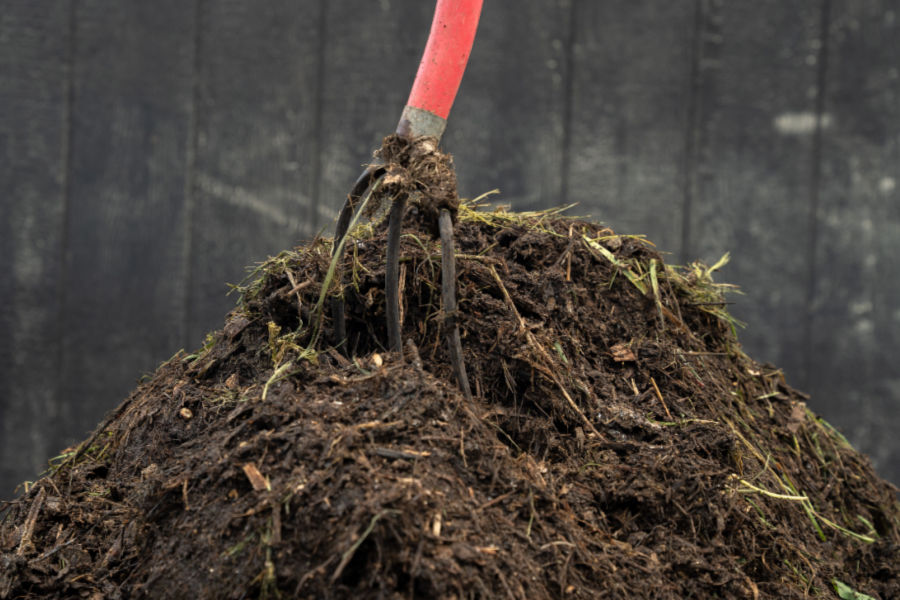
Clearing leaves and old plant material from your flowerbeds in the springtime can create quite the pile of organic matter. So can adding in all of the cuttings from pruning back perennials, shrubs and bushes.
But the abundance of available materials doesn’t end there. Frequent cuttings of spring lawns are another wonderful source of material for a pile. As are leftover hanging baskets and container plants from last year – still filled with decaying plant debris and soil.
The point is, with just a bit of work, you can come up with plenty of compost materials in the spring. But the real key to success when composting is knowing how to turn all of those valuable materials into a powerhouse pile that heats up and decomposes into “black gold” fast!
Although there are a plethora of materials readily available, how you add them, what you add in with them, and how often you attend to them ultimately will determine just how quickly your compost will finish.
The good news is that building and maintaining a pile isn’t difficult in the least. All it really takes is implementing a few tried and true strategies that create an active pile. With that in mind, here are 5 simple secrets to build your pile this spring and get it cooking fast!
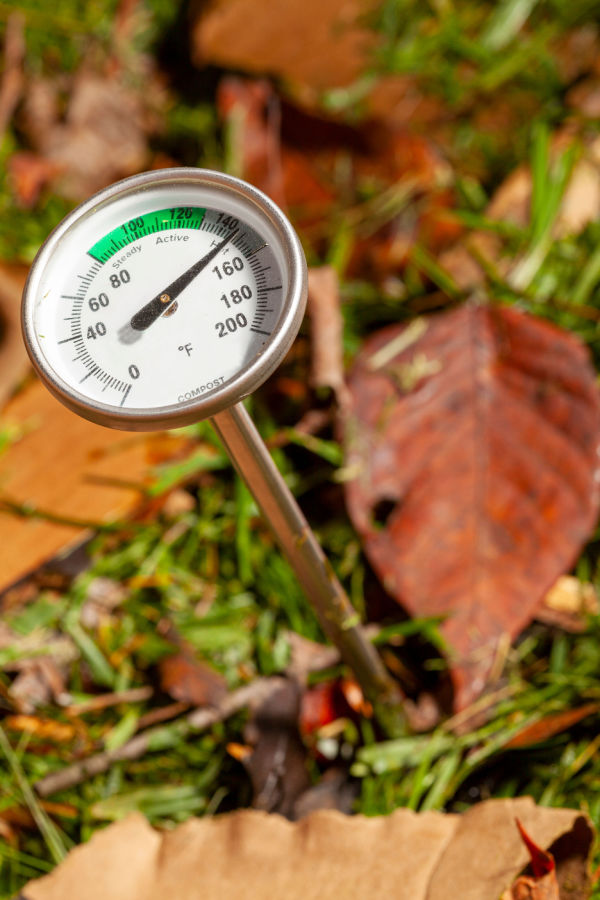
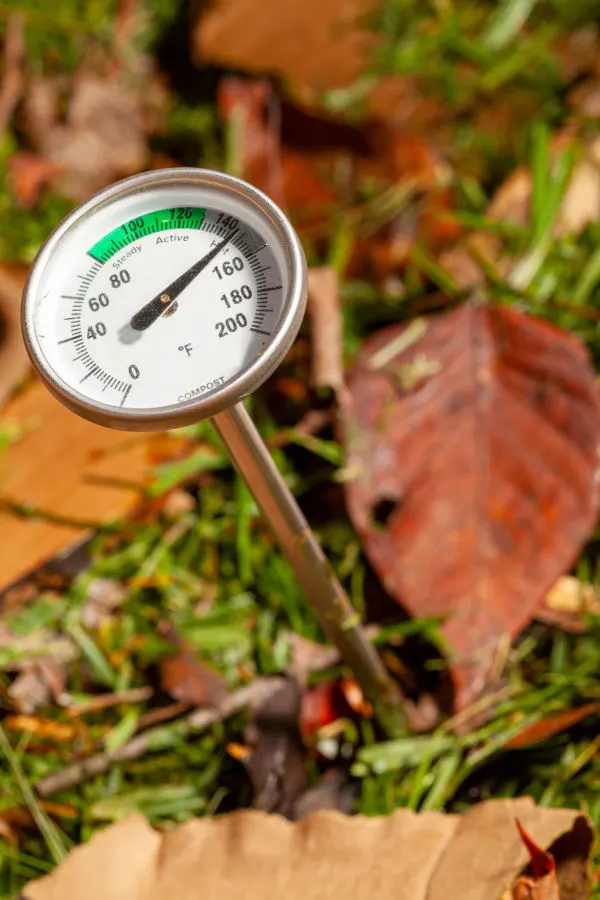
One of the best ways to get a pile to heat up is to make sure it is large enough to generate and maintain its core heat. In order to generate heat, compost piles need to be a minimum of 3′(W) x 3′(L) x 3′(H). Any smaller and there simply isn’t enough material for the pile to stay hot.
Although it can be larger, the 3′ x 3′ x 3′ size works extremely well for homeowners. Its mass is big enough for heating up but still small enough to turn and manage. Larger piles can be difficult to mix and turn, which as you will see later is a huge key to success. (See 3x3x3 DIY Compost Bin Plans)
The size of the debris you add to your pile is a huge factor in how long the pile will take to decompose into usable compost. The larger the pieces going in, the longer it will take for your pile to heat up and the materials to break down.
Whole leaves, large stems and small brush and twigs are slow to decompose. By simply chopping or shredding pieces first, it will speed up the process greatly. It truly is a big key to making compost fast!
For starters, by cutting material up, there is less total surface area that needs to break down. Even more, all of cuts and tears on the smaller pieces expose more edges to the bacteria and organisms that break it down.
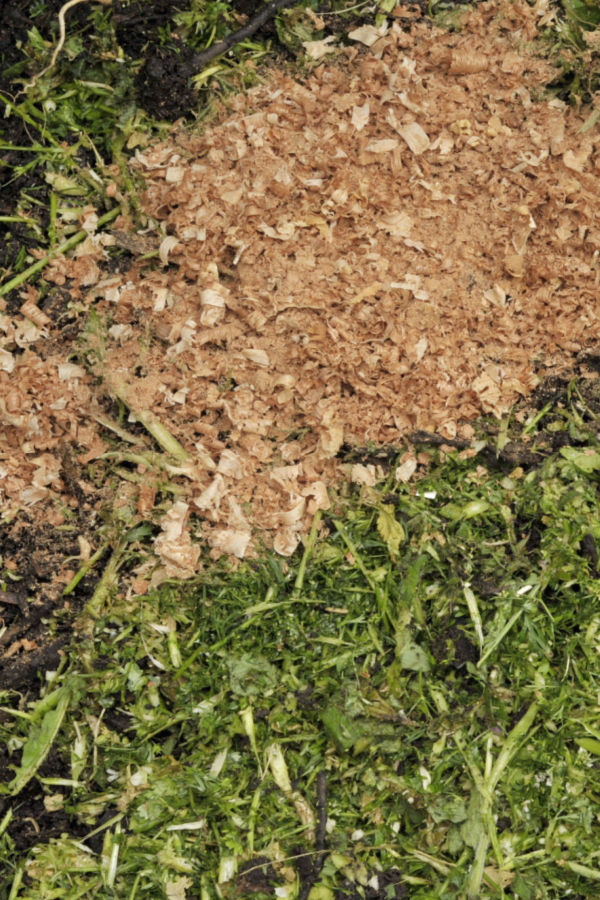
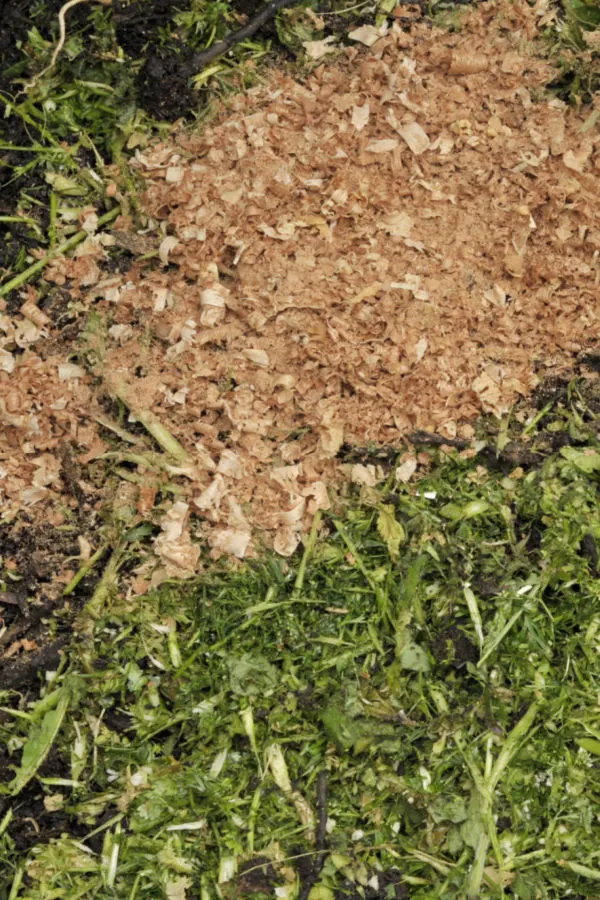
If you have a shredder, it can certainly work well for the process. But a lawn mower or push mower is a great (and much cheaper) alternative to breaking down lighter plant materials (leaves, perennial cuttings, etc.) in short order.
One final note on adding materials – try to get a good mix of materials for a better pile. Compost piles that are made of 4 parts dry (leaves, twigs, dead plant materials) and 1 part green material (coffee grounds, manure, green grass clippings, vegetable scraps) will heat up and work best.
The ratio doesn’t have to be exact, but the closer you are to that blend, the faster your pile will heat up and break down.
In addition to adding a good mix of materials and keeping them small, you also need to help activate your pile with the microbes and organisms needed to break materials down. All piles will eventually develop their own micro-life, but introducing it from the start speeds a pile’s decomposition process up greatly.
To do this, there are two methods that work well – adding compost from an existing compost pile, or adding in a compost starter mix to a brand new pile.
Finished, or nearly finished compost is teeming with all kinds of living bacteria and life. When mixed into a new pile, it will quickly introduce the bacteria and begin to work. How much should you add? Adding in a five gallon bucket of old compost to a new pile is more than enough to do the job.
If you don’t happen to have existing compost, a compost starter is the answer. A compost starter, much like existing compost, introduces bacteria directly into a new pile where it can begin to work and multiply.
Once you have your first pile completed, you can simply start using compost from old pile from there on out. Affiliate Product Link: Jobe’s Organics 09926 Fast Acting Fertilizer Compost Starter
This is why building or investing in a two compost bin system is a great idea. You can always have a pile finished or finishing, while a new pile is getting underway. Having it all in one space also makes it easy and convenient! See: How To Create An Inexpensive Homemade Compost Bin That Works!
In addition to a starter, moisture is a key ingredient for getting a compost pile to heat up. The key is getting your pile’s interior to stay slightly moist, but never saturated or overly wet.
The best analogy to think of for this is a well-wrung sponge. You can feel the moisture, but not enough to see liquid. That is exactly how you want your compost pile to be. If your compost pile is too dry, it won’t be able to heat up. If it’s too wet, it will stop the pile from heating up.
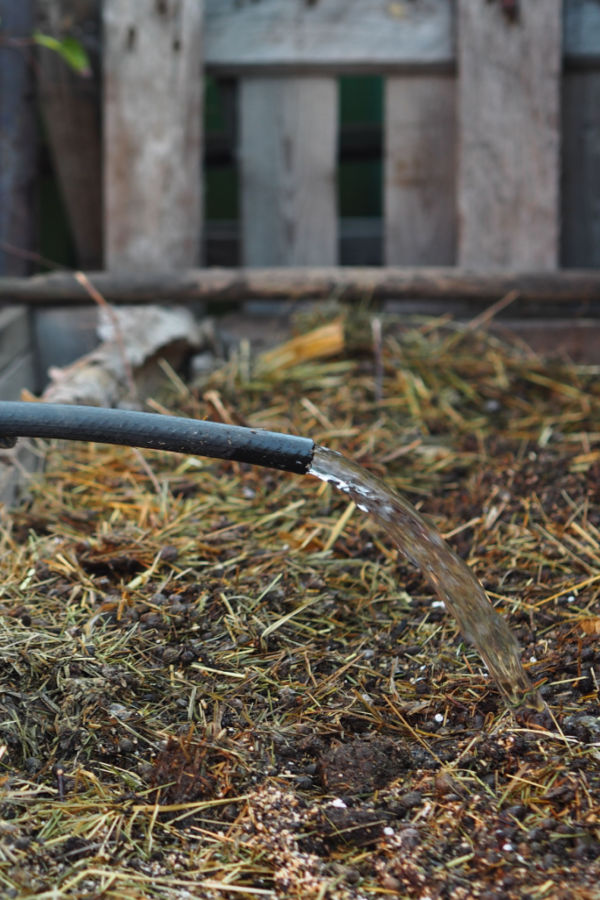
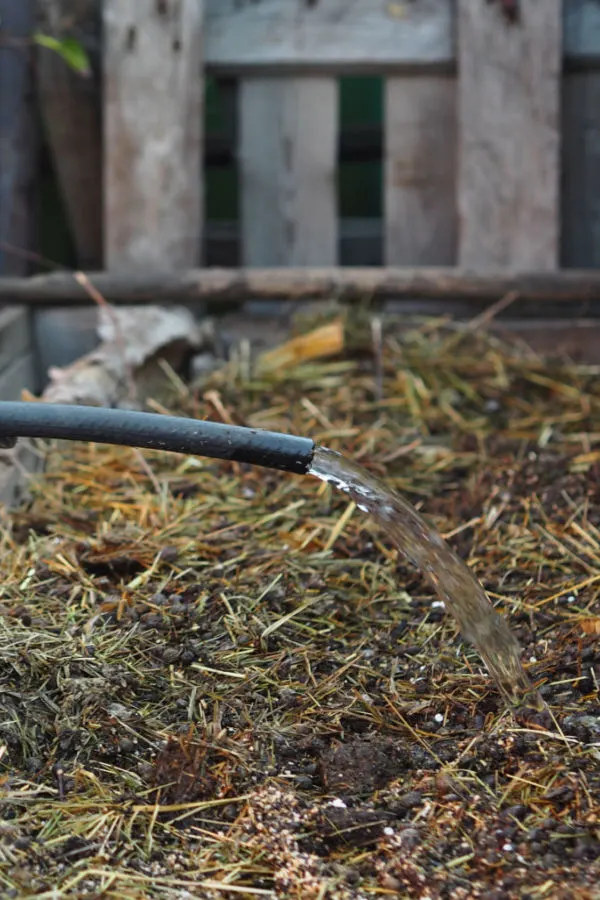
When first building, add just enough water to get the ingredients moist. If you get a lot of spring rain in your area, you may want to put a piece of plastic over your pile to keep it from becoming too wet. And if it’s too dry, add water as needed to keep it moist.
Finally, once you build your spring compost pile, you will need to turn it frequently to give it a steady supply of oxygen. Without oxygen, a compost pile will lose heat and slow its decomposing activity to a crawl.
Use a pitchfork or shovel to turn your pile’s ingredients at least two to three times each week. If you can turn it daily, even better! This process allows oxygen to get into the core of the pile. It also turns the outer cooling edges back inside to heat up and break down faster.
When turning, be sure to add a little water to the core if you see it drying out. With just a little work, you will be rewarded with amazing compost, faster than you ever imagined!
Follow Our Facebook Page For Great Gardening Tips And Advice! This Is My Garden Facebook Page
This Is My Garden is a garden website created by gardeners, for gardeners. Jim and Mary Competti have been writing gardening, DIY and recipe articles and books and speaking for over 15 years from their 46 acre Ohio farm. They publish three articles every week, 52 weeks a year. Sign up today to follow via email, or follow along!
Want to make great compost to power your garden, flowerbeds and more?
A compost pile is a huge asset for the home landscape. The finished compost it creates helps to build and recharge soil in vegetable gardens, flowerbeds, raised beds and more. Even more, it can be used to energize and fertilize plants at every stage of their growth.
But as good as compost is – it can be a challenge to make for many home gardeners. All too often, home compost piles turn into either a mushy mess, or a forgotten mass of twigs, leaves and other yard debris in the back corner of a yard.
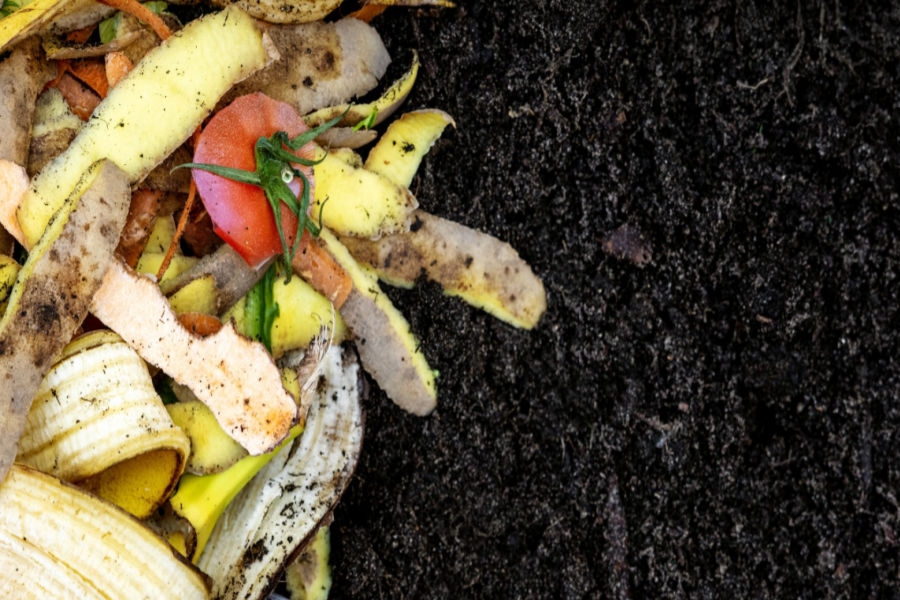
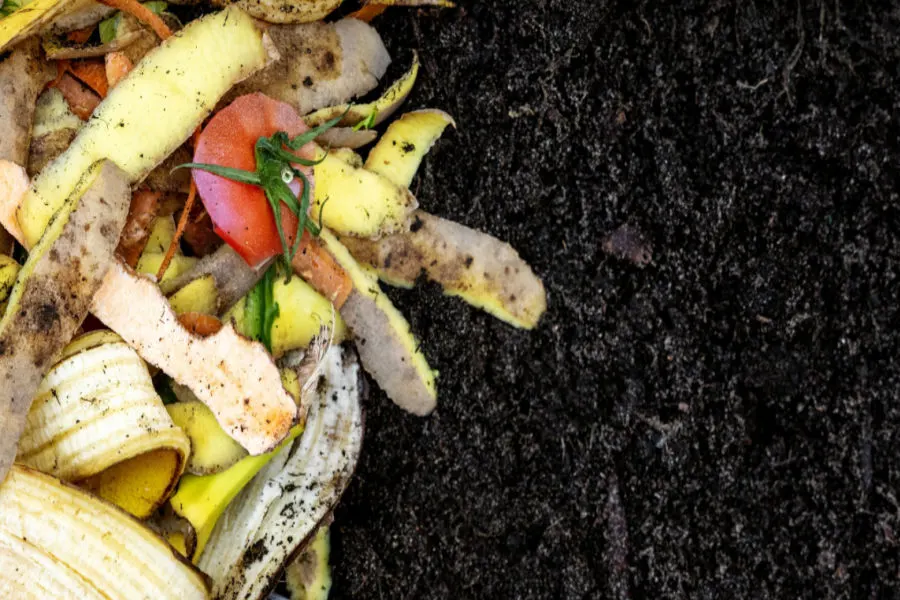
Although any backyard pile will eventually decompose and turn into compost, messy or inactive piles can be an issue. Overly wet or saturated piles can be oily and smelly. Not only can they be tough on the nose, they can also attract vermin. Likewise, dry, crusty, inactive piles can become home to a whole slew of insects and pests as well.
But the good news is, it doesn’t have to be that way! In fact, with just a few simple tips, you can create a fast working pile that heats up quickly, and creates incredible amounts of “Black Gold” for you flowerbeds and gardens.
With that in mind, here is a look at the four simple secrets to creating and maintaining an amazing backyard compost pile!
Want a perfect compost pile that makes great compost as fast as possible? Then shred your ingredients before adding to the pile! One of the biggest reasons home compost piles take so long to decompose is the materials in them are simply too big.
Chopping and shredding materials before adding gives them a jump start on decomposition. All of those torn, rough edges allow for more surface areas to be exposed in the pile. Not to mention, the smaller the material, the less it needs to break down.
Best of all, shredding doesn’t have to be difficult or expensive. Yes, you can invest in a small chipper / shredder if need be, but there are other fast, easy and economical ways to shred materials.
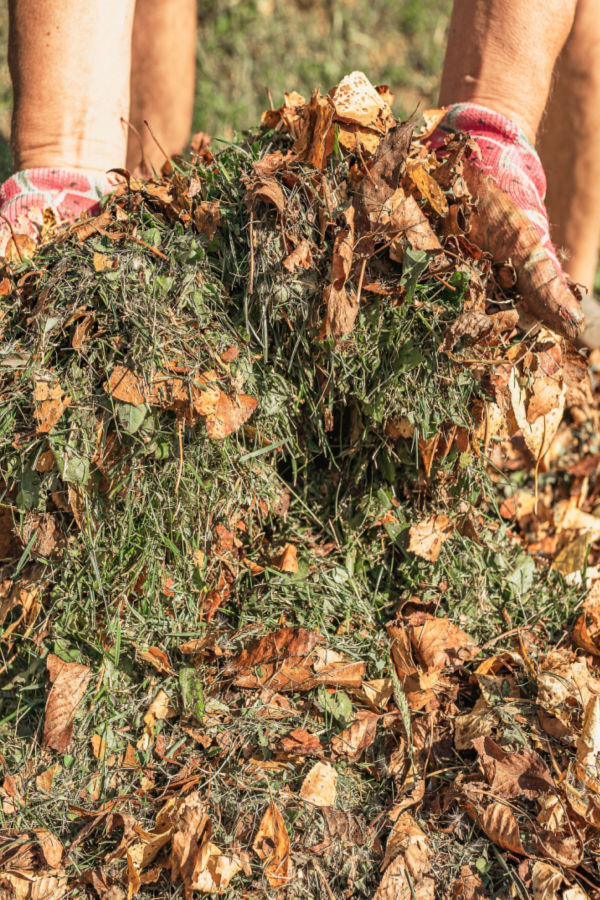
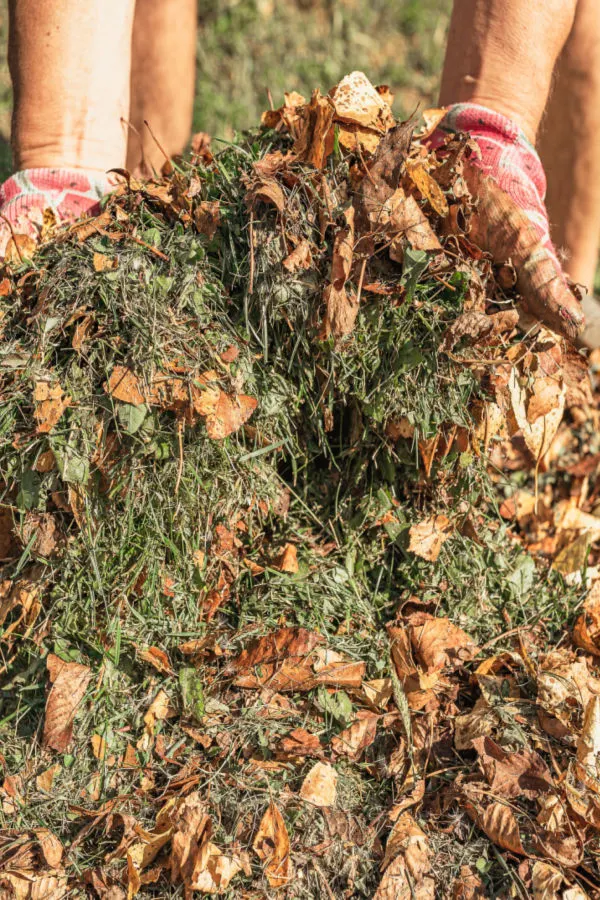
Use a push or riding mower to quickly shred leaves, grass or straw. In addition, cut kitchen scraps with a few extra chops of the knife before adding. But whatever you do, keep those ingredients as small as possible. You will be rewarded with incredible compost all the more quickly.
There are two basic types of materials that go in a compost pile – brown material (inactive), and green material (active). And a compost pile works best when it’s made up of the right mixture of the two.
Browns are carbon based materials such as leaves, twigs, wood chips, ashes, dry grass and clippings. Greens on the other hand are nitrogen based. These are materials that heat up the pile to decompose the browns.
Greens include chicken, rabbit, horse or cow manure, fresh vegetable scraps, green lawn clippings and even coffee grounds. Greens are often the most lacking materials in home compost piles.
So what is the right mix of browns and greens? As a good rule of thumb, a compost pile breaks down best when there is a ratio close to 4 parts of brown material (carbon), to 1 part green (nitrogen).
Do you have to be exact? No. But if you stay close to the ratio, the pile heats up and breaks down faster. As an example, if you put four buckets of leaves in your pile, you need to add a bucket of manure, coffee grounds or fresh green lawn clippings to keep the pile in balance. (See: 5 Things To Never Put In A Compost Pile)
Creating the right-sized pile with those ingredients is also important. If a pile is too small, it will not generate enough internal heat for decomposition. And if it’s too big, you may not be able to turn it at all.
As it turns out, a pile at or around 3′ high x 3′ wide works best. It is large enough to create heat. And yet, still small enough to manage for the gardener when turning.
Like humans, a compost pile needs oxygen to breathe, live and work. And the best way to give a pile oxygen is to turn it frequently.
Turning a pile every few days will drastically reduce the time it takes to create finished compost. As a pile breaks down inside, it uses oxygen to fuel the decomposition. And as the oxygen becomes depleted, the process slows.
But turning the pile frequently reintroduces oxygen into the center of the pile where it is needed most. The more oxygen a pile can get, the hotter it can get in the core. And even better, with more oxygen, it can stay hotter for a longer time period.
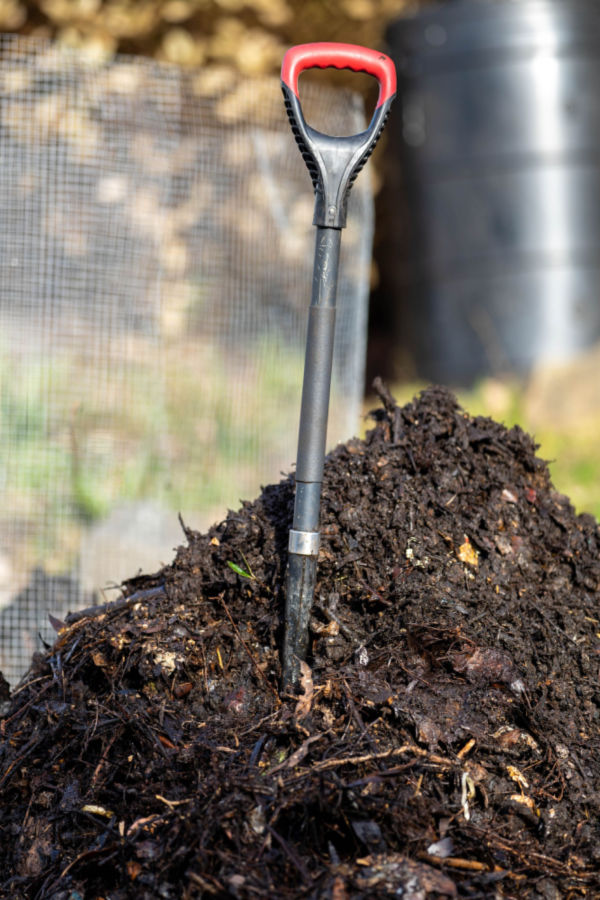
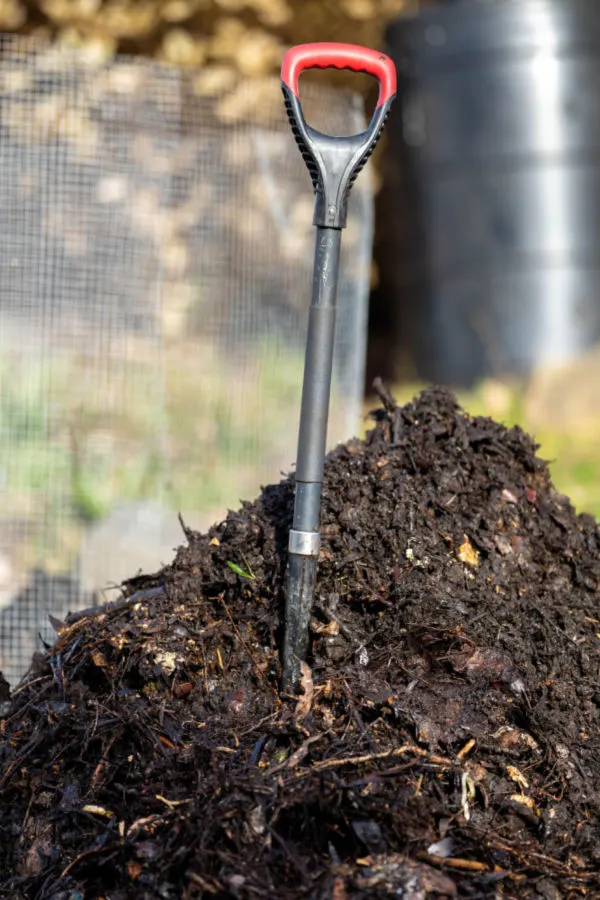
Use a pitchfork or shovel to lift and turn ingredients at least once a week. Every few days is even better. Try to place the outer ingredients in the center of the pile as you flip to create the perfect level of oxygen in the compost pile.
In addition to oxygen, a compost pile needs water to thrive as well. And when there is a lack of moisture within the pile, decomposition will quickly slow to a halt.
As you turn the pile, add a few gallons of water if it appears dry in the center. During extremely hot periods, a tarp can be used to help retain moisture to the pile. Remember, without moisture, the pile will slow decomposition to a crawl.
So how much moisture is enough? A perfect compost pile should have the consistency of a well-wrung sponge. Damp, but not dripping wet is ideal.
Unfortunately, too much moisture can be detrimental to your pile too. A saturated, water-logged pile will slow decomposition even more than a dry pile. Keep piles covered with a tarp during periods of excessive rain to shed excess water. Also, make sure your pile doesn’t sit in a low spot where water can pool.
Finally, when starting a new pile, always use an activator to jump start the decomposition process. An activator is nothing more than a supply of organisms and bacteria that help to start breaking a pile down faster.
The best form of an activator is compost from your old pile! It already has every organism you need to begin breaking down materials.
Finished compost is teeming with all types of bacteria and organisms. And a few buckets of old compost placed into a new pile will quickly re-introduce these organisms to start breaking down the fresh material.
If you are starting a pile from scratch and don’t have access to old compost, use a good quality compost starter as a substitute. Product Link : Compost Starter – Jobes All Natural
Here’s to creating the perfect compost pile this year, and being rewarded with healthier soil and plants!
Follow Our Facebook Page For Great Gardening Tips And Advice! This Is My Garden Facebook Page
This Is My Garden is a garden website created by gardeners, for gardeners. Jim and Mary Competti have been writing gardening, DIY and recipe articles and books and speaking for over 15 years from their 46 acre Ohio farm. They publish three articles every week, 52 weeks a year. Sign up today to follow via email, or follow along!
Did you know that by simply adding a few common ingredients to your compost pile every week, you can create a more productive pile that decomposes faster than ever?
One of the best ways to build better soil and grow healthier and more productive plants is with compost. Adding compost to your garden and flowerbeds helps to re-energize and replenish vital nutrients in the soil. And when used in planting holes or as a top dressing around plants, it can provide them with ready to absorb minerals to power fast growth.
But for most home gardeners, the biggest issue with compost isn’t determining how valuable it is – but instead how to make enough of it and quickly enough to always have it at the ready.
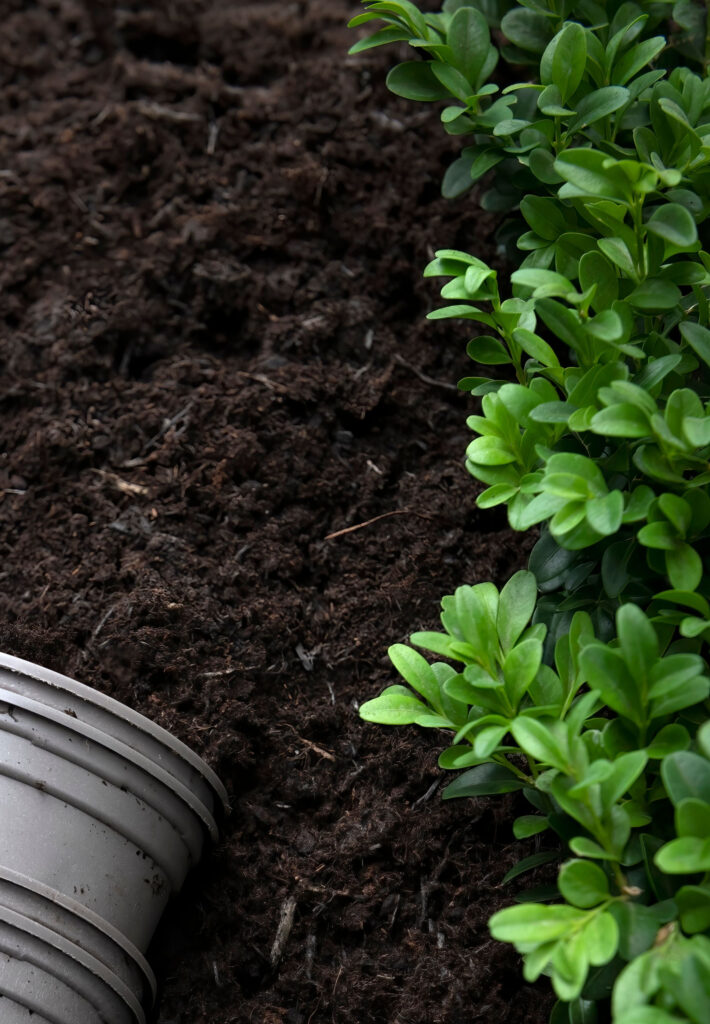
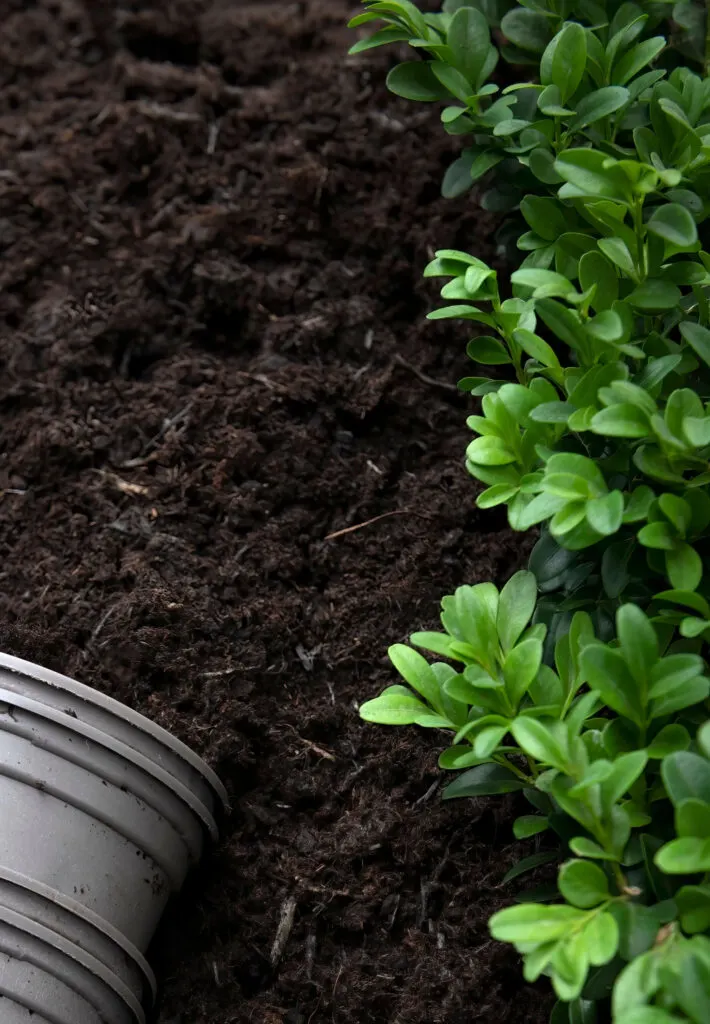
It’s a fairly obvious fact that the more material you can add to your pile, the more compost you will be able to make. But what you put in your pile is very important -as it can have a big impact on the performance and fertility of your compost pile as it ages.
Most home compost piles struggle to decompose at a fast pace. They also usually fail to reach hot enough temperatures to kill pathogens and weed seeds.
Why is this so common? The usual culprit is that most home piles simply don’t contain the right mix of materials to heat the pile to a hot enough temperature. A hot pile not only kills off weed seeds and harmful bacteria, it also speeds up the decomposition process immensely.
So what heats up a compost pile? For the most part, materials that are nitrogen based or “green materials” are the ingredients that energize the decomposition process – along with proper water and oxygen. And unfortunately, all three of these ingredients are exactly what most home piles usually lack the most.
To work best, a compost pile should consist of 4 parts of brown (carbon) materials, and 1 part green. Brown materials are decayed debris, dead grass, leaves, straw and other “dead” material.
These materials are usually more than plentiful to find and add – and exactly why home piles usually have an excess of them as part of their make-up. But the good news is there are also plenty of the “greens” and other ingredients that are needed to heat your pile up available – and they are right at your fingertips!
With that in mind, here is a look at 5 key materials that can easily be gathered and added to your pile each and every week to get your pile cooking fast!
Coffee grounds are an incredible source of energy for a compost pile. Even better, they are easy to obtain, even if there isn’t a coffee drinker in your house.
When coffee is brewed, the acid that is in the ground beans is removed. And what remains is a bevy of trace nutrients and minerals that can help warm up a pile fast. Spent coffee grounds contain nitrogen, and nitrogen is one of the key ingredients for heating up a pile.
Each and every morning, make it a habit to take your coffee grounds to your pile. And don’t forget to throw in the paper filter too. Coffee filters are completely compostable, and make adding the grounds easy and mess free. Just be sure to use unbleached filters in your coffee maker.
And what if you aren’t a coffee drinker? Ask your neighbors and friends to save their grounds for you. Even better, check with your local coffee shops, many will gladly save their grounds for gardeners.
And don’t forget to save your coffee grounds in the winter months too. Not only can you keep them to power your compost pile, but also to use when planting in the spring to energize plants! (See: How To Save Coffee Grounds In The Winter Without Having Them Mold)
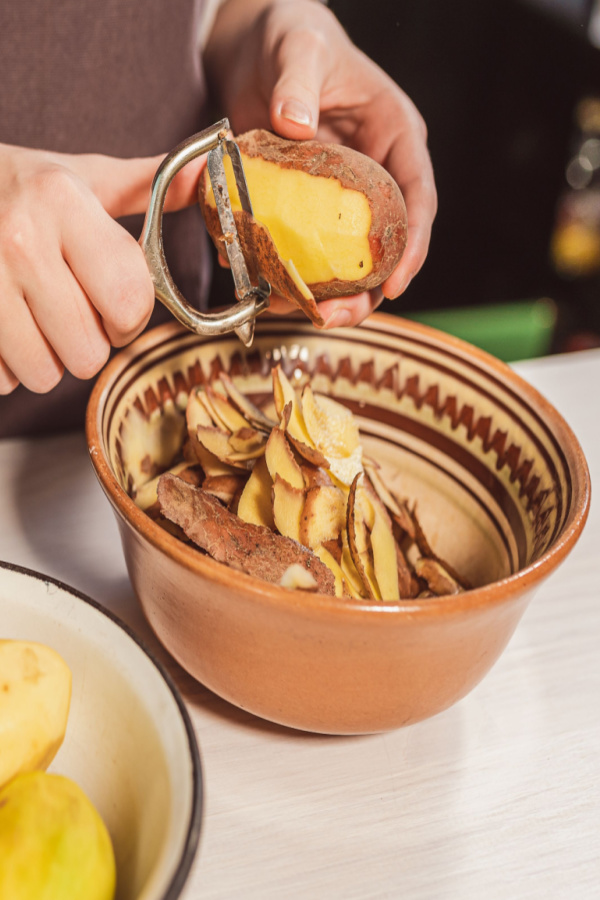
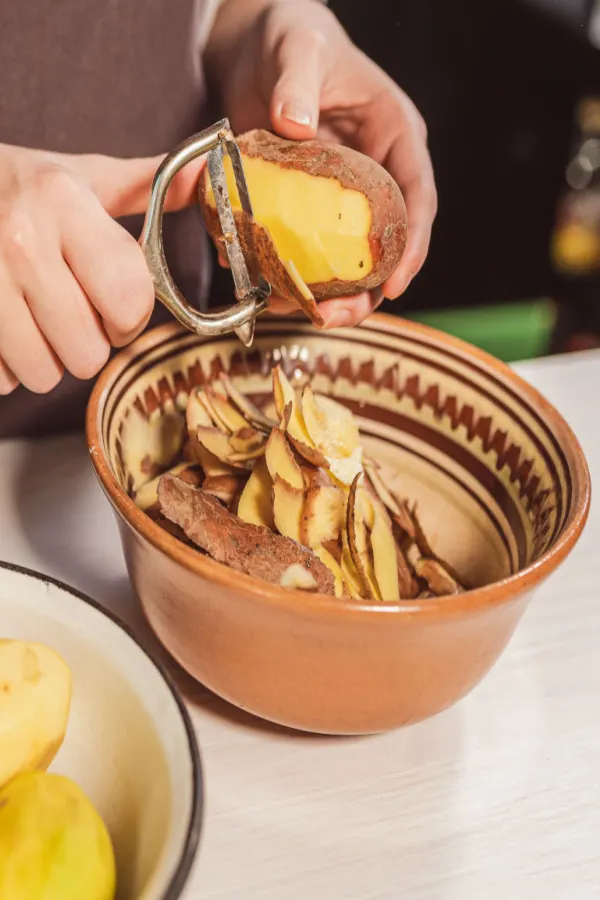
Stop throwing those vegetable peels and scraps down the garbage disposal! Vegetable peels from potatoes, carrots, bananas and other garden vegetables are excellent for heating up a pile quickly. And in most home kitchens – they are readily available.
Not only do they break down quickly, they add an enormous amount of nutrients to your pile. Take your vegetable scraps out regularly and place them into the middle of the pile. In fact, it is important to always put all new materials into the middle so they can generate heat quickly.
Because egg shells contain traces of nitrogen, calcium and moisture, they too are a wonderful green material. And can they ever help add big power to a compost pile!
When adding egg shells, always crush the shells up as finely as possible to speed decomposition. Crushing the shells also helps to expose more of their nutrients faster to the center of the pile, helping to heat it up in the process.
Just as with coffee grounds, even if you are not a consumer of eggs, there are plenty of neighbors, friends and family that are. They really can help add tremendous power to your pile.
This may surprise a few folks as a key weekly ingredient, but water is actually one of the most vital of all ingredients to be adding regularly. Without moisture, a compost cannot generate heat. It will simply stall, cool off, and slow to a crawl when it comes to decomposition.
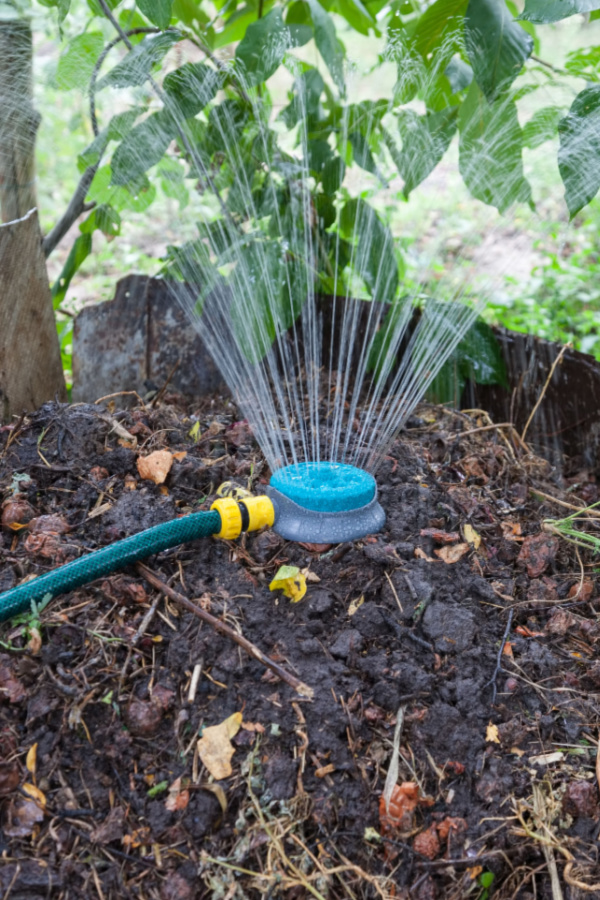
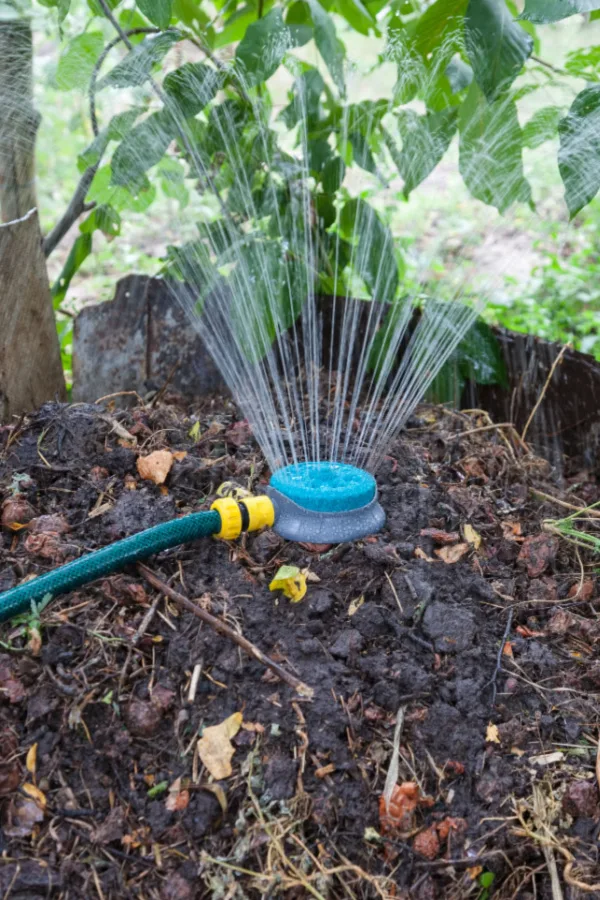
A good compost pile will feel like a well-wrung sponge. In the hot and often dry summer months, a pile can dry out quickly. Each and every week, check the moisture level of the center of your pile, if it is drying out, it’s time to add water.
Water both the interior and exterior of the pile. Apply enough moisture to get it to a moist but not saturated state. If it is extremely hot, you can also use a canvas or shade cloth to help keep the pile from drying out too quickly.
Just as is the case with water, a pile cannot function properly without oxygen. Oxygen fuels the entire heating process, and when absent or in limited quantities, a pile will cool off quickly.
The good news is adding oxygen is easy. And thankfully, there is little need to use air hoses or oxygen tanks to do so! Instead, by simply turning or flipping the ingredients in your pile a few times each week, you can easily introduce oxygen into the core of the pile – right where it’s needed most!
Turning your compost pile is a must to produce a hotter pile. For best results, turn your pile at least twice a week. Once a day is even better. The more oxygen available – the more your pile will heat up. And in the end, the more compost you will have for your plants!
Here is to getting the most from your compost pile this year. And remember, the more materials you add – the more compost you will have to power your soil and plants!
Follow Our Facebook Page For Great Gardening Tips And Advice! This Is My Garden Facebook Page
This Is My Garden is a garden website created by gardeners, for gardeners. Jim and Mary Competti have been writing gardening, DIY and recipe articles and books and speaking for over 15 years from their 46 acre Ohio farm. They publish three articles every week, 52 weeks a year. Sign up today to follow via email, or follow along!
When it comes to making great compost in quick fashion for your garden, flowerbeds and more – you can have a great deal of success simply by avoiding four of the most common composting mistakes that many home gardeners make.
Making homemade compost is an incredible way to power your flowers, vegetables, shrubs and trees. Not only is compost full of minerals and nutrients, compost is also teeming with beneficial bacteria and microorganisms as well.
Together, all of that goodness helps turn ordinary soil into a super-charged, humus-filled powerhouse. And that is exactly why it’s so important to have a hard-working home compost pile to make as much as you can as quickly as you can!
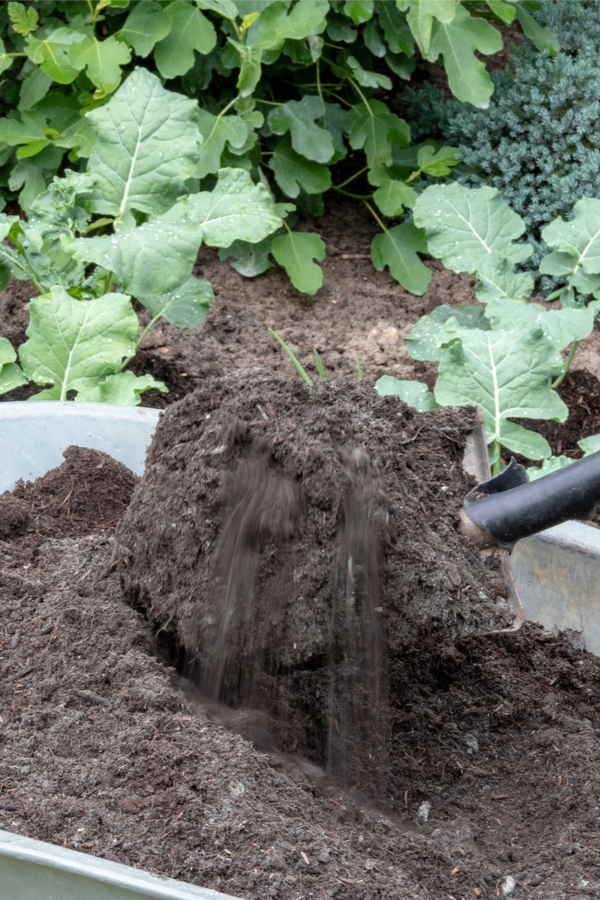
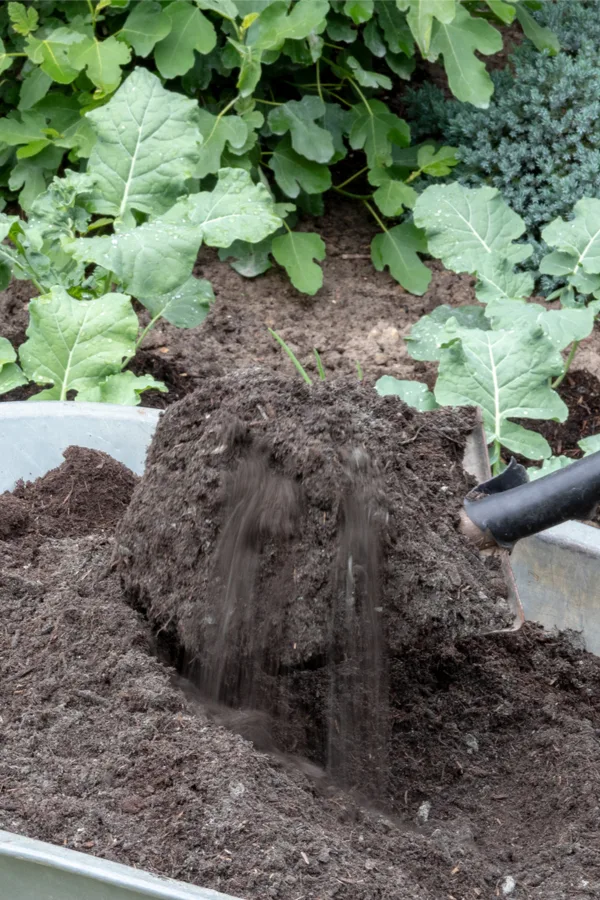
There is nothing more frustrating for a home gardener than a compost pile that doesn’t break down in a timely fashion. A poor compost pile can be more than just frustrating, it can also often be unsightly, smell badly – and attract more than its fair share of vermin and pests.
With that in mind, here is a look at four of the most common issues that can occur in a home compost pile – and how to avoid them to create a hard working compost pile.
By far, the single biggest mistake made in home compost piles is having the wrong mix of materials. To break down fast, a compost pile needs to have the right mix of carbon and nitrogen based materials.
Carbon materials are more dry-based materials. They do not serve to instantly heat up a pile, but do break down to give back their nutrients. Carbon materials include straw, dead grass, sticks, twigs, leaves, etc.
Nitrogen materials are more wet or green. They include green grass, vegetable peels, manure, coffee grounds and fruit scraps and rinds. Nitrogen materials are what helps to generate heat in a pile.
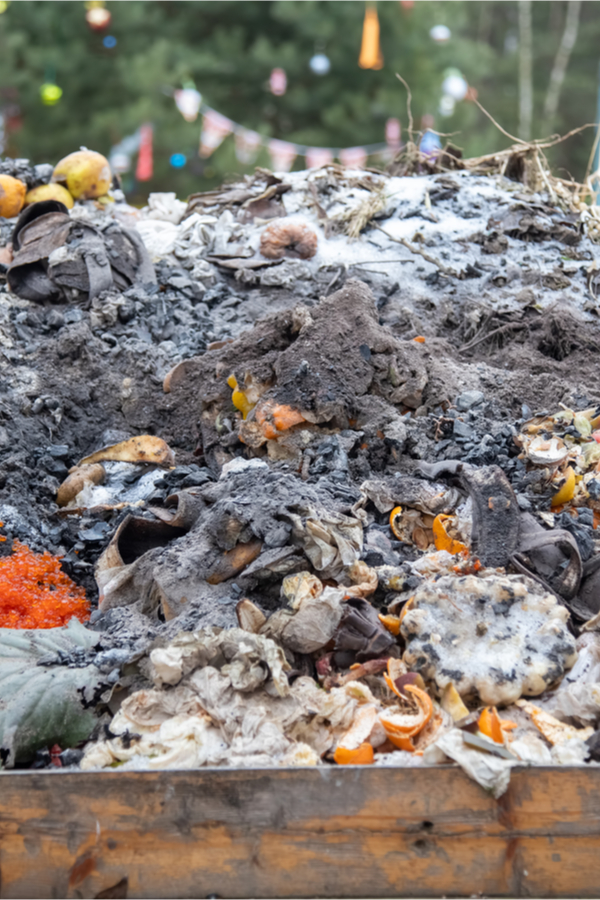
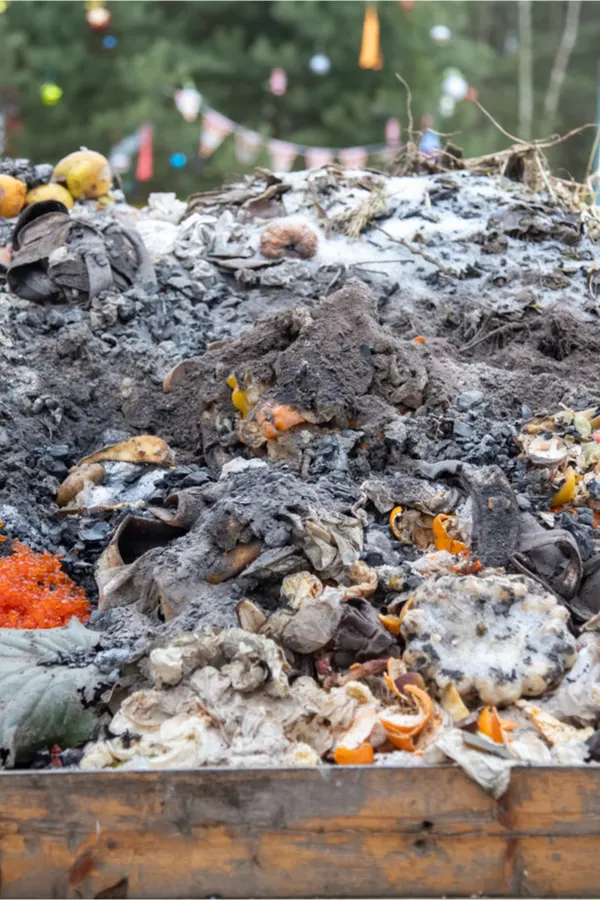
To have a pile that decomposes well, you need to have a ratio of about 4 parts carbon to one part nitrogen. If there is too much carbon and little nitrogen, a pile can’t heat up. If there is too much nitrogen and not enough carbon, a pile can become overly wet and mushy, and again, no heat will occur.
As an example : a giant pile of leaves can take years to decompose. But blend it with a good ratio of nitrogen materials, and it can become great compost in as little as 3 months!
Just remember to try to keep your pile close to the range of four (4) parts carbon, and one (1) part nitrogen. It doesn’t have to be exact, but the closer to the ratio – the faster you will make compost!
Without oxygen, a compost pile can’t generate heat. And, without heat, decomposition will slow to a crawl. The result? A stagnant, poor performing pile.
Unfortunately, without turning your pile on a consistent basis, the center of the pile becomes void of oxygen. But by flipping and turning a pile, oxygen is sent back into the core. And as it does, decomposition and heating of the pile can continue at full strength.
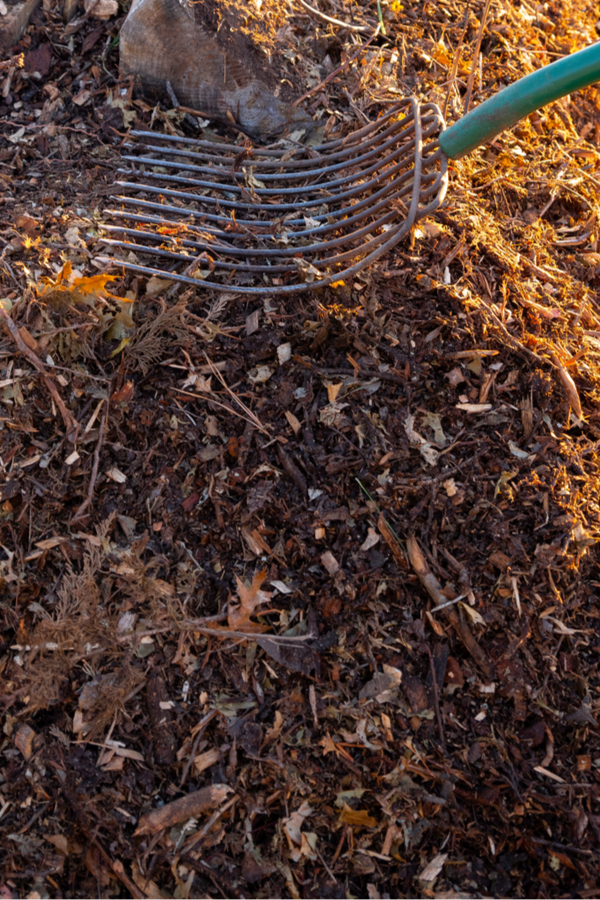
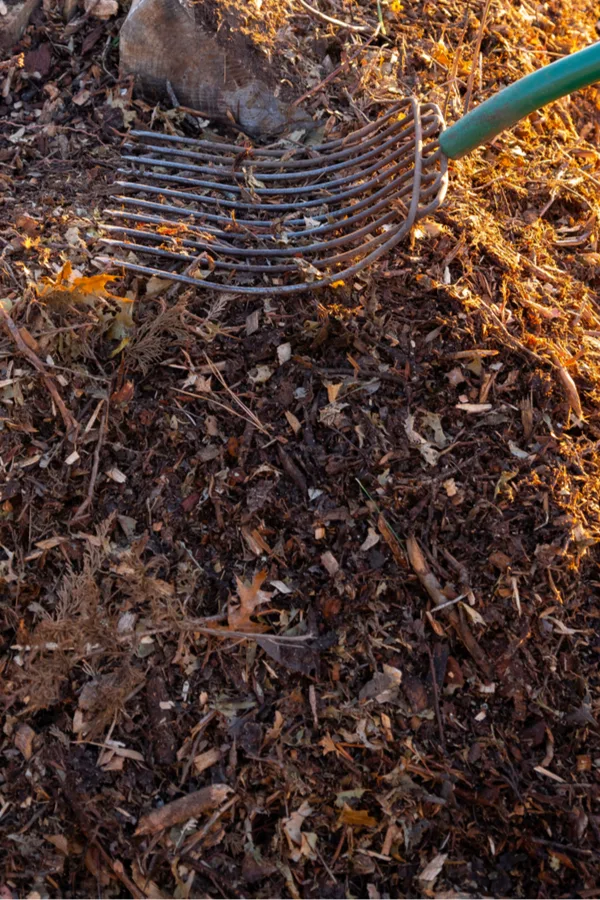
The easiest way to turn a pile is to use a pitchfork. It allows you to flip the materials, taking the outer and cooler remnants and placing them in the middle of the pile. And as you flip, you add more and more air to the mix.
The more frequently you turn your pile, the better. Once a day is ideal for making fast compost. But at the very least, turn it at least a minimum of twice a week to keep oxygen supplied to the core. One final advantage to turning often is that the constant air keeps odors to a minimum.
Much as a compost pile needs oxygen to work, it also needs moisture. But, and here is the kicker, not too much moisture. Having your pile at an ideal moisture level is critical to keep the decomposition process in motion.
As a rule of thumb, materials in a perfectly balanced pile should feel like a well wrung out sponge. Not too wet, not too dry – but just slightly damp.
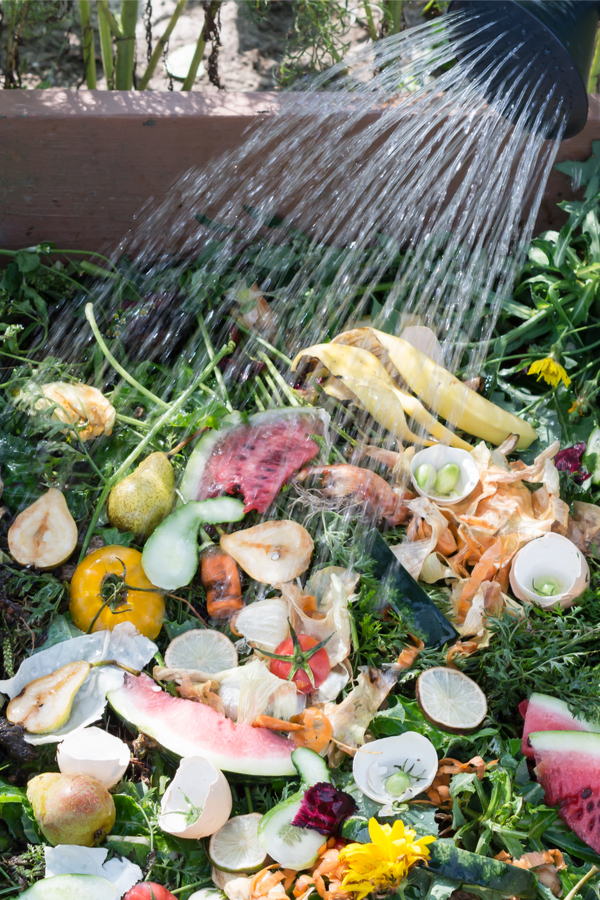
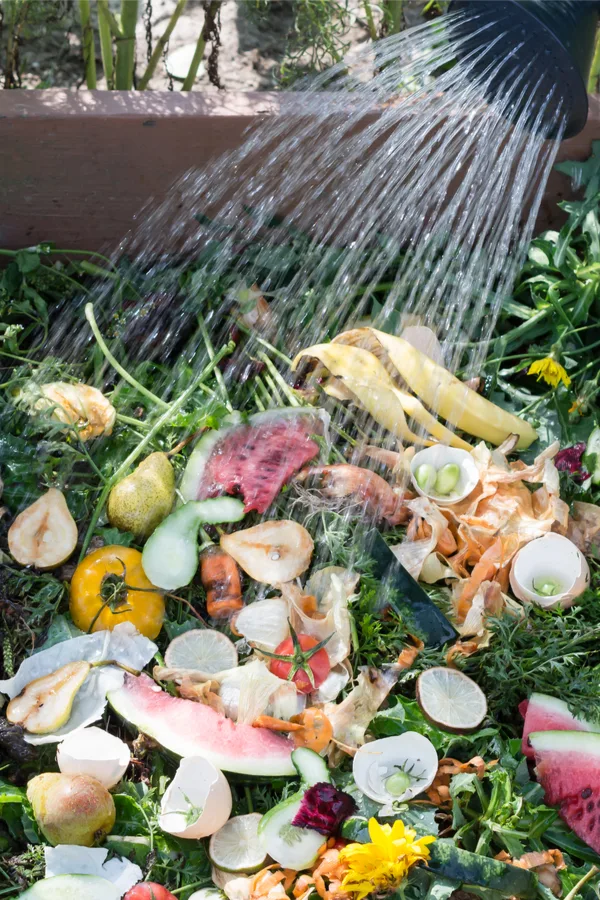
A pile that is too wet will unfortunately snuff out any oxygen. A wet pile is usually a more odorous pile, as the materials become slimy and slick. If your pile is too dry, simply add water to increase activity. For wet piles, add more dry carbons. And if you are getting too much rain, simply cover it to keep it from becoming soaked.
If you are experiencing a lot of rain, you can cover your pile to keep it from becoming too moist. And if you are experiencing a long dry spell, add water as you flip your pile.
Another big issue that will cause all kinds of issues for a home compost pile is adding materials that should be never be placed in a pile.
A compost pile can only be as good as the materials that are placed into it. Although it is true that nearly everything will eventually decompose, there are some things that should never be added to a backyard pile.
At the top of that list are meat and oily products. Although scraps of meat will indeed compost over time, adding them to a home pile can create a whole slew of issues. For starters, meat products can create a pile with an incredibly rancid smell.
If you have ever taken a whiff of spoiled meat, you know exactly how bad it can be. Even worse, these horrific odors also attract mice, rats, raccoon and other pests and vermin.
In addition to excluding meat, cooking oil and oily substances should be left out as well. Not only do they create offensive odors, they also keep oxygen and water from absorbing into the pile. Both of which happen to be key elements for getting a pile to decompose.
The manure of cats and dogs should always be left out of a pile as well. Pet feces can carry harmful pathogens that can pass through to the soil and your plants.
It is, however, more than okay to add the manure of farm animals. Chicken, rabbit, horse, cow, goat and even sheep manure are all great additions. Not only do they add a multitude of nutrients, they can heat up a pile in quick fashion!
When adding materials to your pile, always refrain from adding diseased plants or the seed cores from your garden or flowerbed plants.
Most backyard compost piles fail to reach a center core that is hot enough to kill pathogens and disease. Without high enough temperatures in the core of a pile (140°+), any soil born disease that is present can easily pass through to new plants.
That same hot temperature is also important to kill the seeds of weeds, vegetables and flowers. That is exactly why you do not want to toss whole tomatoes, peppers, or seed heads from flowers into the pile. See : Should You Put Weeds Into A Compost Pile
Unfortunately, all of those will pass through to the compost, and become a weeding nightmare for your where ever you use that compost next year. Always chop out or remove seeds heads before placing plants into the pile – it can save big headaches later!
Here is to avoiding the most common composting mistakes – and making great compost!
Follow Our Facebook Page For Great Gardening Tips And Advice! This Is My Garden Facebook Page
This Is My Garden is a garden website created by gardeners, for gardeners. Jim and Mary Competti have been writing gardening, DIY and recipe articles and books and speaking for over 15 years from their 46 acre Ohio farm. They publish three articles every week, 52 weeks a year. Sign up today to follow via email, or follow along!
Looking for the best and most effective ways to use compost in your vegetable garden? Compost is by far one of the most powerful ingredients you can add to your garden.
Not only does it help build more fertile soil, it also aids in growing healthier and more productive plants. Compost teems with healthy bacteria and microorganisms that bring soil to life. It also happens to be overflowing with a whole slew of nutrients.
Even better, those nutrients are completely broken down and in a form that can easily be absorbed into plants. And that is exactly the reason so many gardeners refer to compost as “Black Gold”.
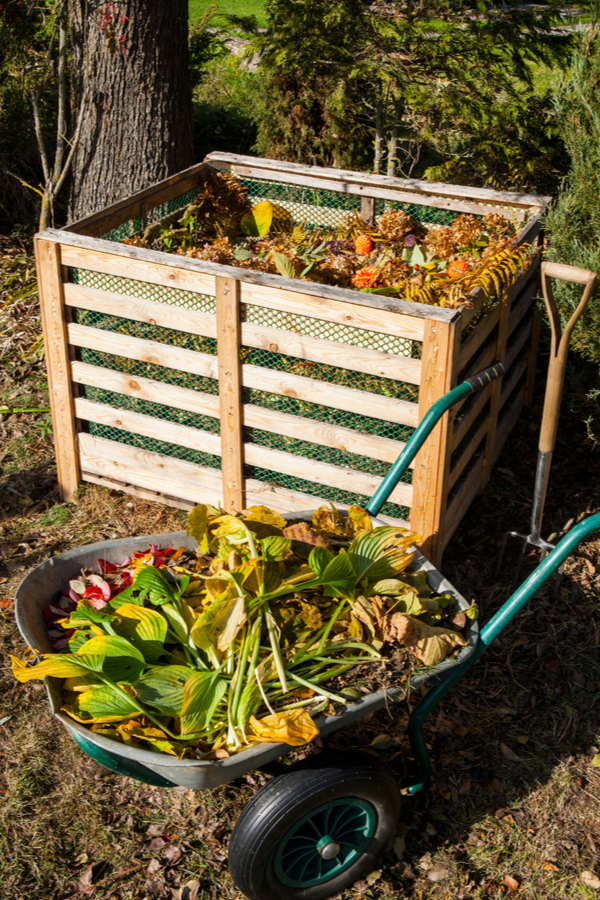
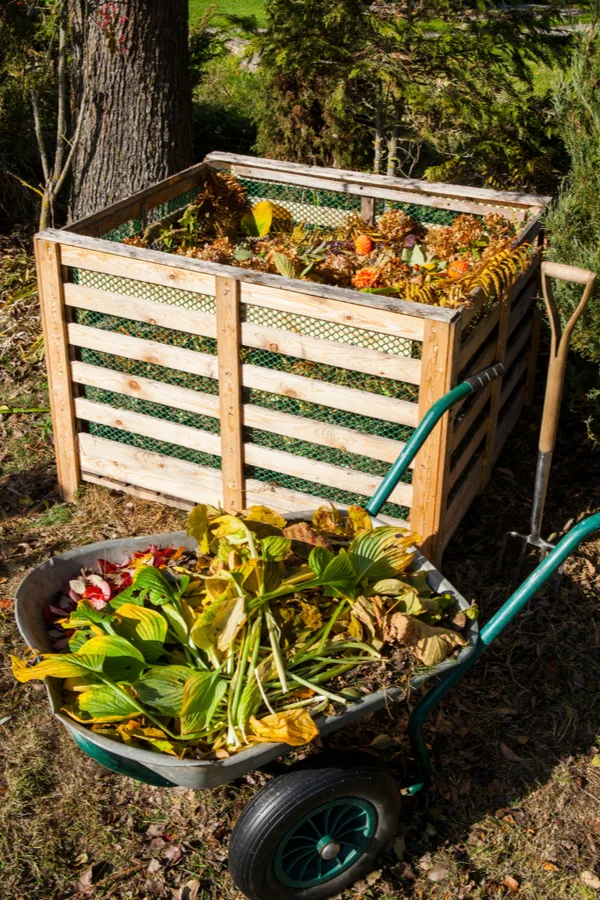
But the issue for many gardeners isn’t the value of compost. Instead, knowing just how amazing it is, the real problem is having enough on hand to power all of their growing needs.
Unfortunately, making compost isn’t exactly a fast process. Even the best home piles and compost bins still take months to produce finished, ready-to-go compost. And that is only if they are filled with the perfect mix and getting plenty of attention! (See: How To Make Compost Fast!)
So what is a gardener to do? Although purchasing compost commercially in bulk or bags is always an option – it can certainly be quite costly.
Short of trying to find or make more compost, the best solution is to use the compost you do have as effectively and efficiently as you can. And that is exactly what today’s article is all about! With that in mind – here is a look at 3 of the best ways to make the most out of the compost you have on hand this year.
There is no better way to provide seeds and young vegetable transplants a better start than by adding compost to their planting hole. It also allows you to use your available compost right where you need it most – near a plant’s roots.
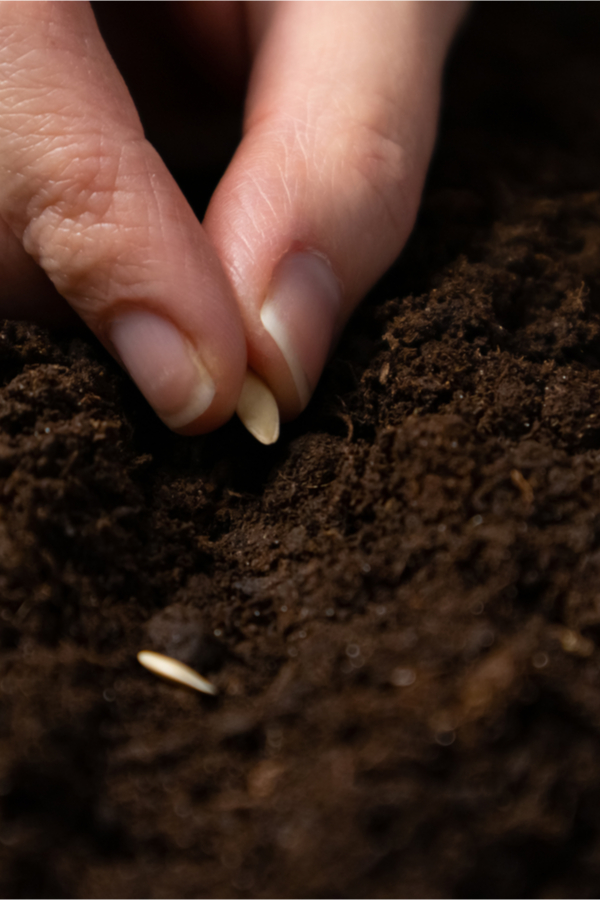
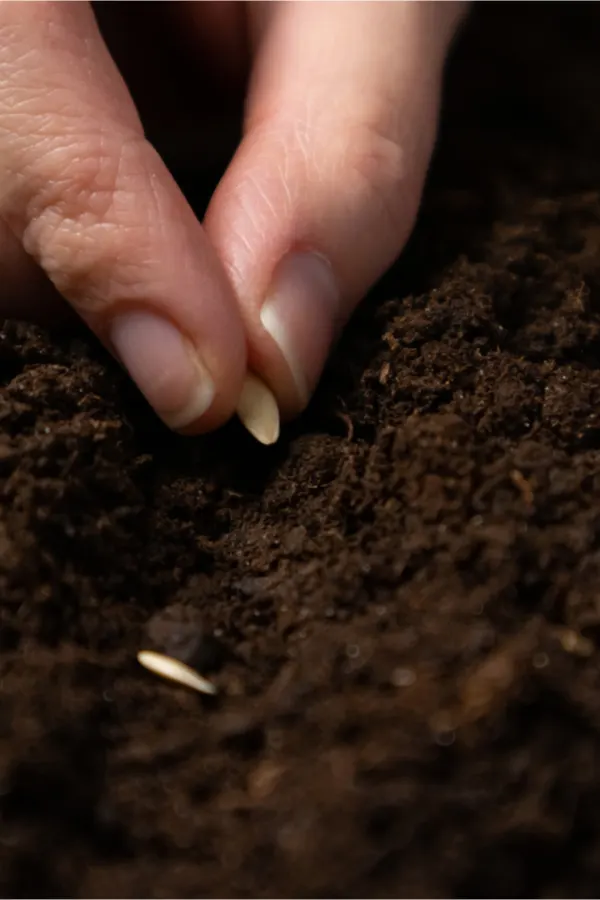
For vegetable transplants such as tomatoes, peppers and cucumbers, fill the planting hole with a 50/50 mix of soil and compost. This creates a loose, powerful soil mix right around the plant’s roots, which feeds the plant in quick fashion.
That same compost also helps hold valuable moisture near the root ball. This is incredibly effective at helping tender young plants stay hydrated as they acclimate to the soil.
Even more, the loose nature of the soil mix allows the roots of transplants to expand quickly. And the faster and more vigorous roots can grow – the healthier and more productive the plant will be.
For seed crops, compost helps in a couple of unique ways as well. For starters, when seeds are planted in a rich mix of soil and compost, it helps speed germination. The compost helps to hold moisture around the seed coating, giving it a better opportunity to sprout.
Once the seeds sprout, the loose make-up of compost also helps the plant’s roots establish quickly. And as the plants start to grow, they begin to soak in the minerals and nutrients of the compost to power even more growth.
The best method for using compost with seed crops is to add it directly into the planting trench. Dig your seed trench to an inch beyond the recommended depth. Next, fill the trench partially with an inch of compost.
To complete planting, plant seeds into the compost, and then fill the trench back in with a 50/50 mix of soil and compost. Your seeds will thank you with fast germination, and strong, early growth!
Another effective use for compost is using it as an energy packed mulch around plants. By creating a “compost ring” around the base of plants, it can help to regulate soil temperature, repel weeds, and power plants – all at the same time!
Place a two to three inch thick layer of compost about ten to twelve inches in diameter around each plant. Every time you water or it rains, the nutrients from the compost will leach down to the roots. It is the perfect way to provide a slow and steady fertilizer to plants!
Last and certainly not least, you can use your compost to create one of the most incredible, all-natural liquid fertilizers around – compost tea!
Compost tea is simple to make but so powerful for energizing plants. To create, all you do is soak compost in water! The resulting liquid absorbs much of the nutrients in the compost. It can then be used to water and fertilize plants, absorbing into their roots and foliage to provide the perfect boost of power.
Unlike many synthetic fertilizers, compost tea won’t burn plants. And because it is 100 percent natural, it is perfect for using on all of the edible crops in your garden.
Best of all, once you strain the compost, the remnants can go back into your compost pile to recharge and be ready to power plants again. See: How To Make Compost Tea
Here is to using the compost you have on hand in the best way possible – and to powering your garden plants like never before – naturally!
Follow Our Facebook Page For Great Gardening Tips And Advice! This Is My Garden Facebook Page
This Is My Garden is a garden website created by gardeners, for gardeners. Jim and Mary Competti have been writing gardening, DIY and recipe articles and books and speaking for over 15 years from their 46 acre Ohio farm. They publish three articles every week, 52 weeks a year. Sign up today to follow via email, or follow along!
When it comes to being ready to plant, grow & maintain your garden or flowerbeds this year, there are four essential garden supplies that can really help make a difference between smashing success, or a less than desirable growing season. And it is ever important to have them on hand and at the ready right from the start!
Once spring arrives, gardening chores arrive in an instant. Before you know it, you are in the thick of planting, watering, mulching, fertilizing and more. And it can get overwhelming quickly!
One moment, you are planting a young transplant into your vegetable garden, waiting patiently for it to grow. Just like that, in the blink of an eye, it’s time to fertilize. But wait! Now here comes an invasion of aphids and whiteflies – and you need a quick solution.
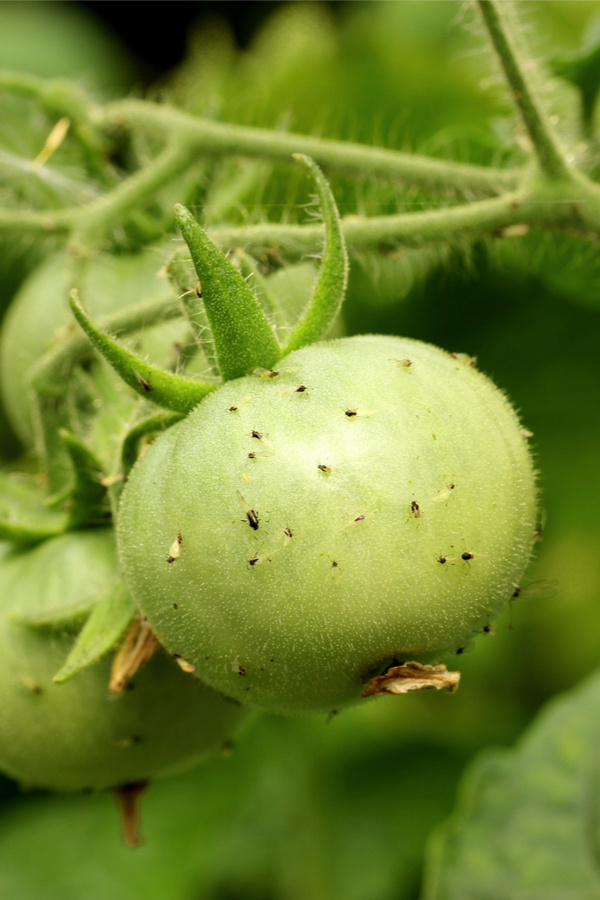
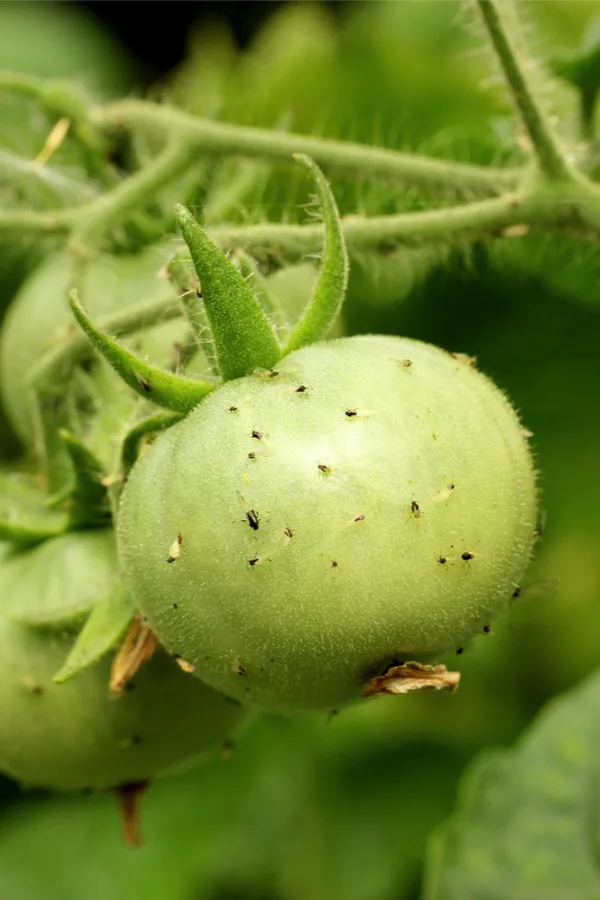
Waiting too long to fertilize or treat an insect issue can spell big trouble. In fact, a single pest issue can explode almost overnight if you are unable to treat the problem quickly.
Unfortunately, when it comes to maintaining your garden and flowerbeds, timing is everything. And not being prepared, or more importantly, not having the right planting soil, supplements or remedies on hand when you need them most can spell disaster for your plants.
Whether you love flower gardening, herb gardening, vegetable gardening – or enjoy all three, it is important to be at the ready. With that in mind, here is a look at 4 essential supplies every gardener should have ready to go this spring!
Above all else, having a good supply of compost on hand is an absolute must for any gardener. Not only for maintaining healthy soil, but for powering your plants to their best.
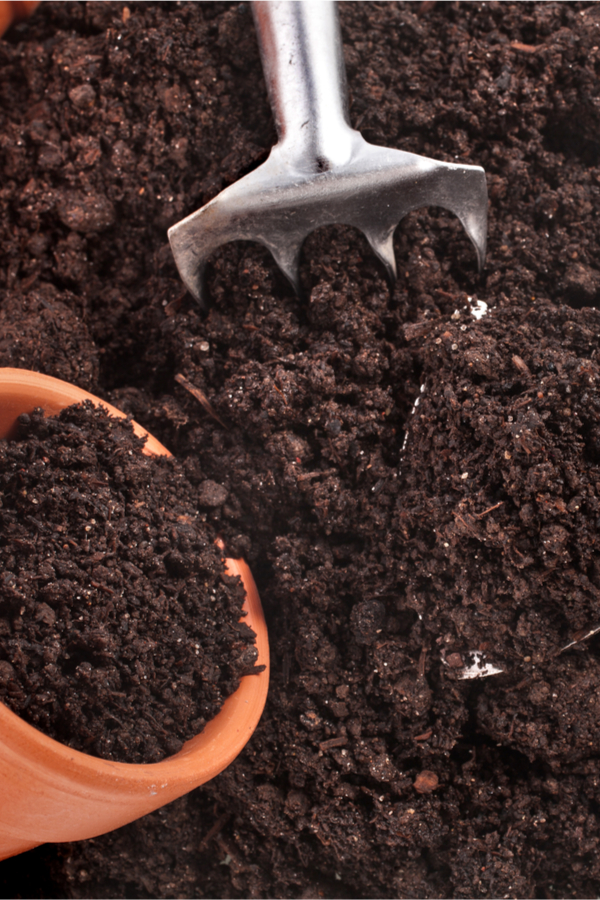
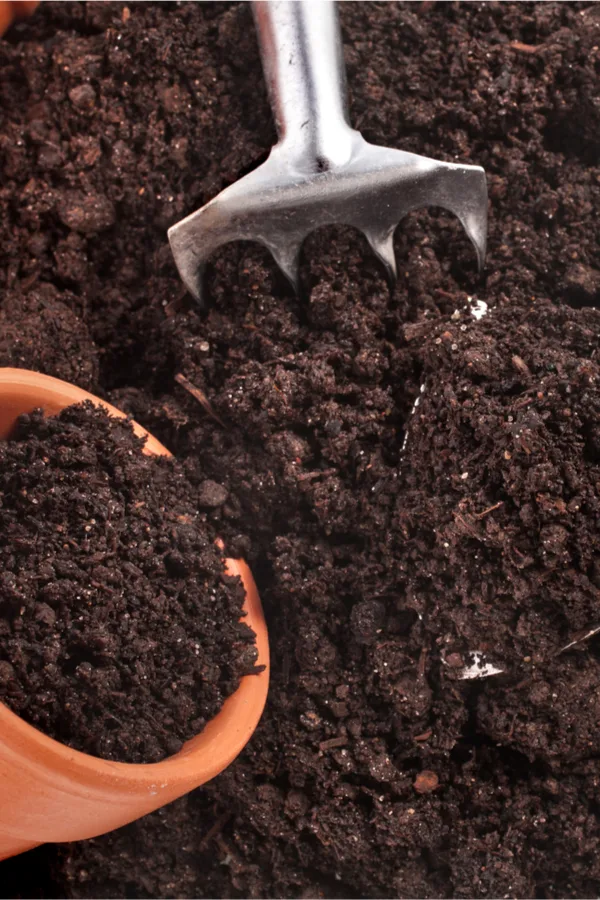
Compost is wonderful for energizing annual flowers, vegetable plants, herbs, perennials, shrubs and more. And in a multitude of ways! With its perfect balance of nutrients that absorb into plants with ease, it is the ultimate organic fertilizer.
When mixed into planting holes, it helps loosen the soil and gently feed the tender roots of young transplants. Compost is also excellent for adding to potting soils, or for using as a power mulch on top of container and hanging basket plants.
If that wasn’t enough, soaking compost in water also creates an amazing fertilizing tea. One that is powerful and fast acting with a great balance of nutrients. Even better, it won’t burn plants like typical fertilizers can often do.
Perhaps best of all, compost tea is simple to create at home. In fact, with just a bit of water and a bucket, you can make it anywhere. Compost tea truly is the ultimate organic liquid fertilizer for nearly any plant a gardener can grow. (See : How To Make Compost Tea)
Always, always, always make sure you have compost at the ready. It can, of course, be made with ease right in your backyard. And completely for free! But if need be, you can also purchase bagged compost to keep on hand when supplies run low.
If you have never used worm castings to power your plants, you won’t believe the difference it can make! Just like compost, worm castings are overflowing with nutrients. Not only that, they are extremely easy for plants to absorb.
Worm castings are a charming name for what are really just the excrement of worms. Before you get squeamish, castings are dry to the touch, and basically odorless. But do they ever contain serious power for plants!
Worm castings can be used everywhere to provide energy to plants. They can be used in planting holes or on top of the surface as a slow-release fertilizer. They can also be soaked in water to create an excellent liquid fertilizer.
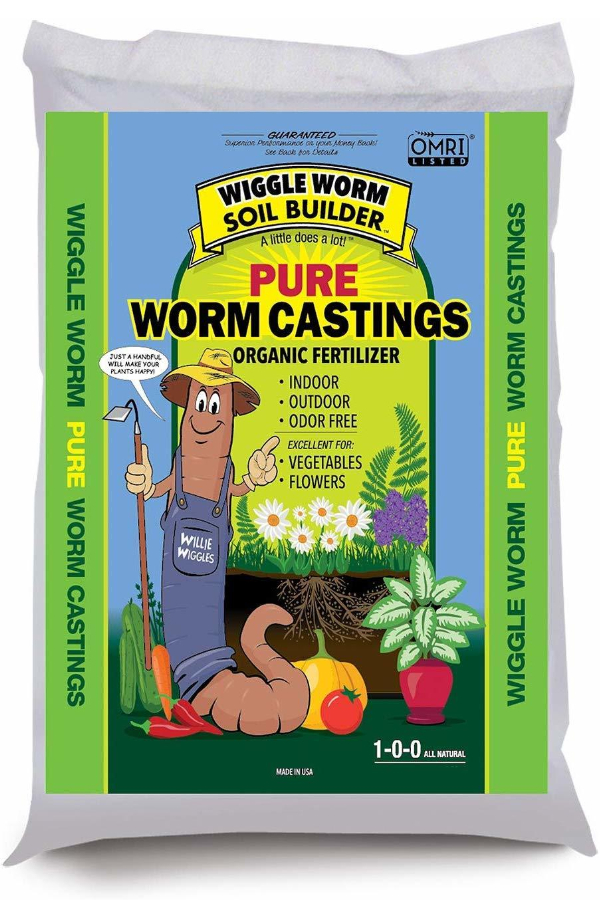
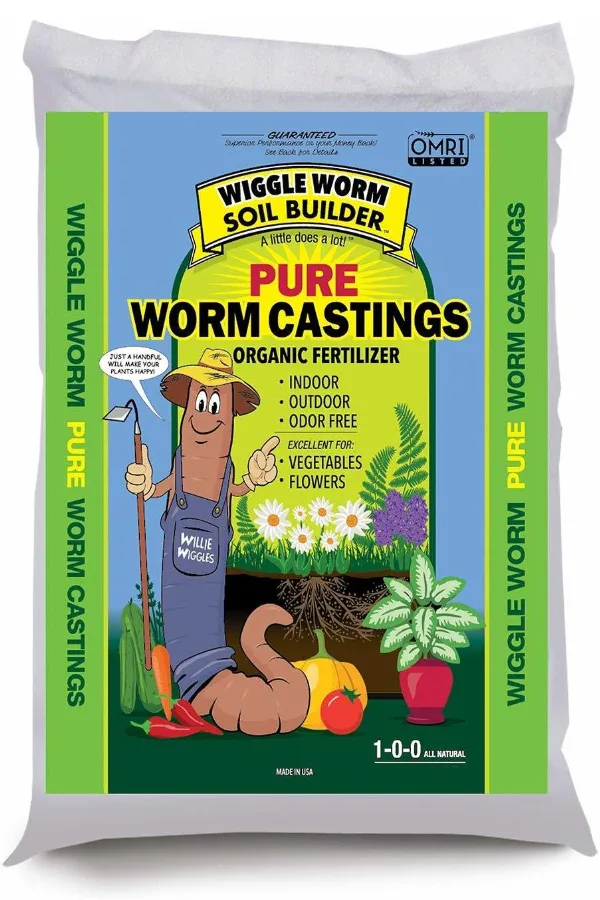
Best of all, just as with compost, they will not burn or over-power plants. Instead, they release a slow, steady stream of nutrients that can keep your vegetables and flowers growing strong all season long. Product Link : Worm Castings
If compost and worm castings are incredible plant powering materials, the next two garden supplies (Neem oil & diatomaceous earth) are amazing and all-natural plant protectors.
If you garden for any length of time, you are going to have issues with pests. And having these two supplies on hand and at the ready is a must.
Especially if you don’t want to use harsh, man-made chemical or pesticide sprays!
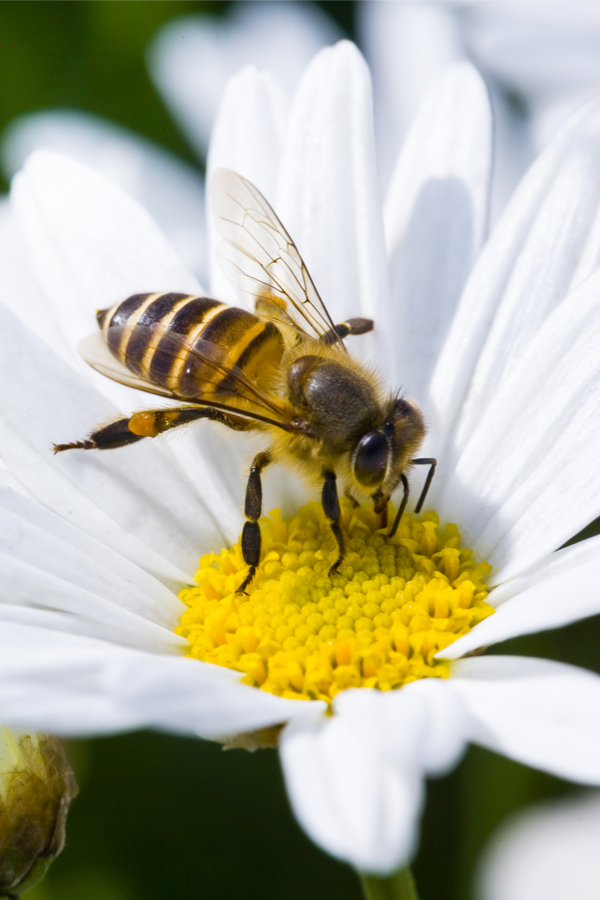
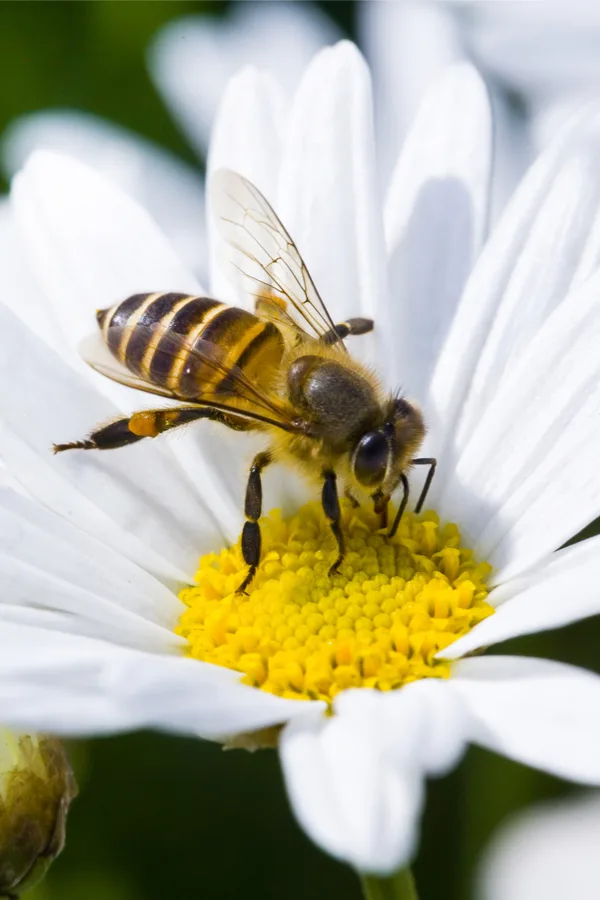
Lets start with the amazing protective properties of neem oil. Neem oil is an all-natural liquid made from pressing the seeds of a neem tree. You can mix the oil with water and spray the liquid without the worry of injuring pets, children or adults – or damaging the plant.
Neem oil is great for controlling many common garden pests such as aphids, mites, beetles, whiteflies, moths and more. Not only is it 100% organic, it will not harm important pollinators such as bees and butterflies. Product Link : 100% Neem Oil
If there is one organic material that can help both your plants and you to an incredibly productive, yet extremely low-maintenance gardening season – it is mulch.
Yes, believe it or not, mulch is the unsung hero of low-maintenance gardening. Both for flowerbeds, and in the garden. And it is exactly why you should always have plenty on hand to apply as needed.
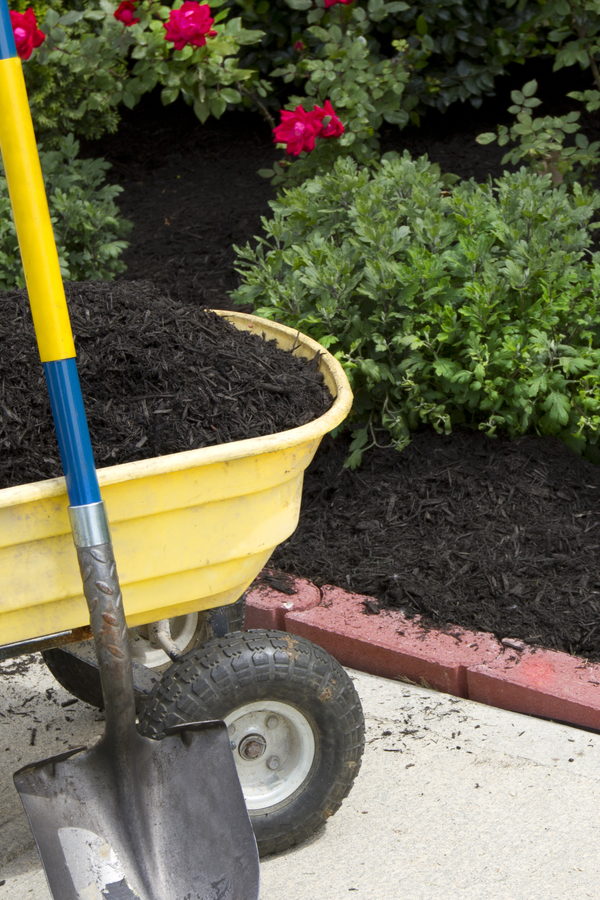
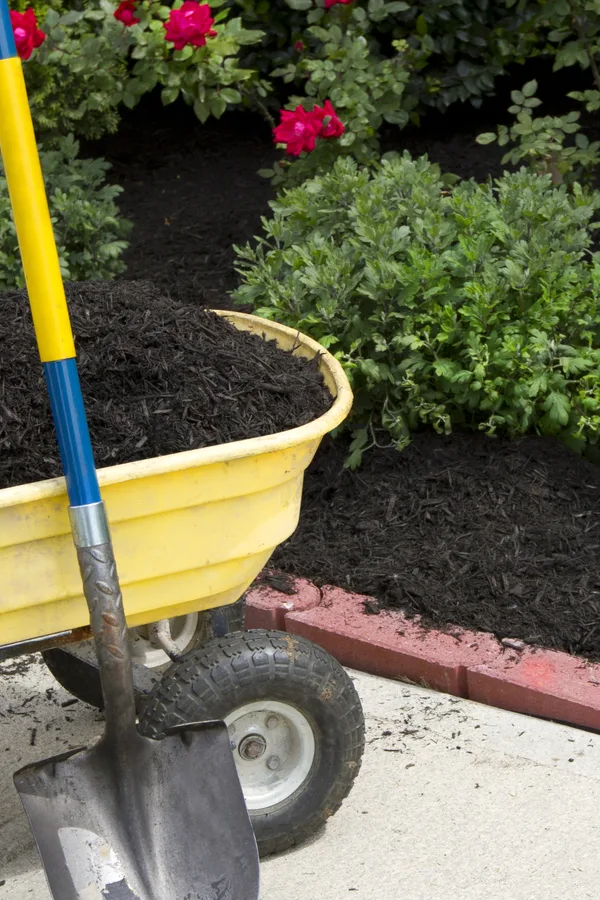
Whether using hardwood or bark mulch in flowerbeds, or straw, grass clippings or shredded leaves in the garden, keeping your soil covered is the ultimate key to healthy plants, and easy-care gardening.
A proper mulching of plants can keep weeds out, moisture in, and your weeding tools in the garden shed. Flowerbeds should have a minimum of 4 to 6 inches for weed control.
The same goes for the mulch you choose for your vegetable plants in the garden too. A heavy application will do wonders for keeping weeds at bay! (See : How To Eliminate Weeding In Your Flowerbeds – For Good!
Here is to being ready for garden season, and to having the essential garden supplies you need on hand.
Follow Our Facebook Page For Great Gardening Tips And Advice! This Is My Garden Facebook Page
This Is My Garden is a garden website created by gardeners, for gardeners. Jim and Mary Competti have been writing gardening, DIY and recipe articles and books and speaking for over 15 years from their 46 acre Ohio farm. They publish three articles every week, 52 weeks a year. Sign up today to follow via email, or follow along!
One thing is for sure, when it comes to composting, all leaves are not the same – and that is why it is vital to know what leaves are best for composting, which should be used in moderation, and which varieties of leaves should be left out of your pile completely!
Autumn is here, and that means there will soon be leaves littering the ground. Leaves are actually one of the best resources around for gardeners. Especially when you consider they are completely free for the taking.
Leaves can be used all throughout the landscape. They are wonderful for helping cover and protect plants from the constant freezing and thawing winter can bring. They can also easily be incorporated into garden and flowerbed soil to help recharge depleted nutrient levels.
But maybe best of all, the leaves of autumn, in all of their abundance, are the perfect addition for building an incredible fall compost pile. Not only are they bountiful, they are loaded with nutrients. Nutrients that energize the compost, all while adding large amounts of organic matter to it as well.
Unfortunately, not all leaves have the same value to a compost pile. While some varieties are filled with goodness, other tree’s leaves can have very little nutritional value. Even worse, some can actually be toxic to plants when used anywhere near them.
With that in mind, today’s article is all about knowing which of those falling leaves are good for composting, and which are best to use in moderation, or not at all. To start off, let’s take a look at the best of the best when it comes to composting leaves
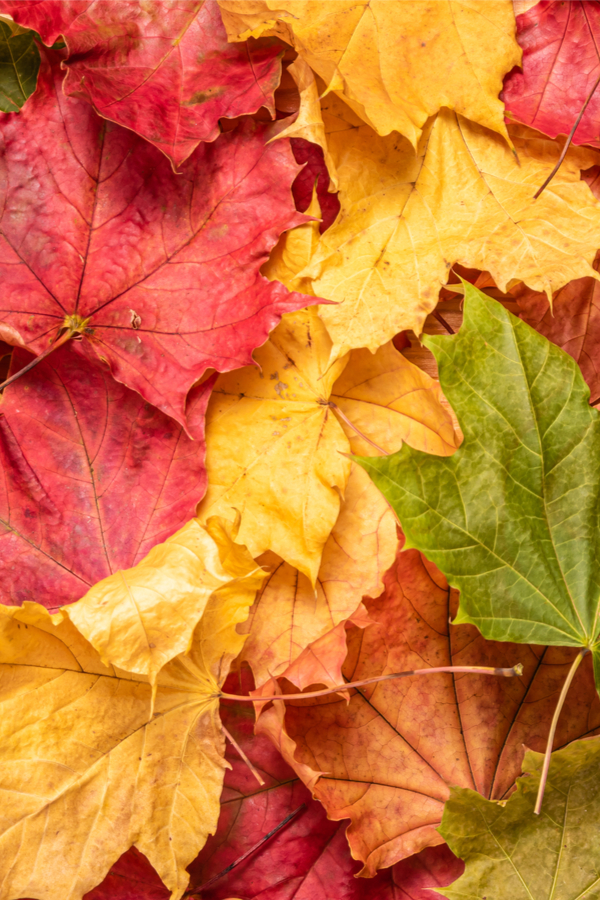
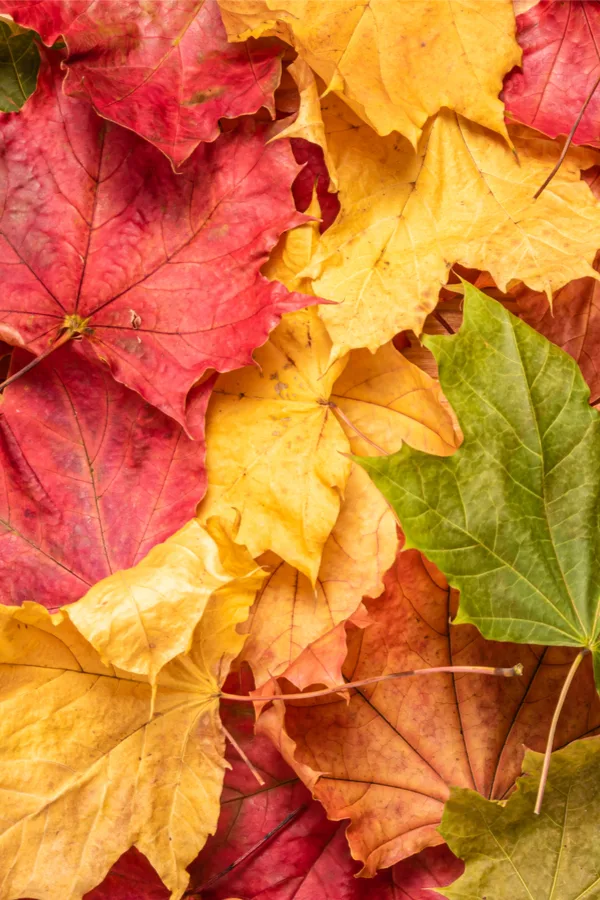
When it comes to the best of the best, maple leaves are certainly at the top of the list. Maple leaves have higher levels of nitrogen and calcium, which of course, are both perfect for plants, and a compost pile.
The thin skins of maple leaves also shred easily and break down quickly in a compost pile. But maple leaves also have another big advantage for compost piles in that they are extremely low in lignin.
Why is a low lignin level important? Because lignin levels are crucial when it comes to how fast your compost pile will break down. Even more, lignin has a significant impact to the nitrogen levels in your finished compost, and the soil you will use your compost in.
Without getting overly technical, lignin is an organic polymer that helps to form cell walls in wood, bark and leaves. The more lignin that is present, the harder it is to break down the material. Hence, the longer it will take to break down in a compost pile.
But high levels of lignin also cause another issue in that they love to devour nitrogen. As lignin decomposes, it actually consumes nitrogen to help the process.
By using leaves with high lignin levels, you can actually end up with less nitrogen in your soil. As you will see below, one of the common denominators of good leaves versus bad leaves is their lignin level.
The leaves of all fruit trees are another great choice for composting. Fruit tree leaves have good levels of nitrogen, phosphorous and potassium. Like maple leaves, they also have low levels of lignin.
With their thin walls, fruit tree leaves also break down extremely fast. In fact, they are among the fastest of all leaves to completely incorporate into a compost pile.
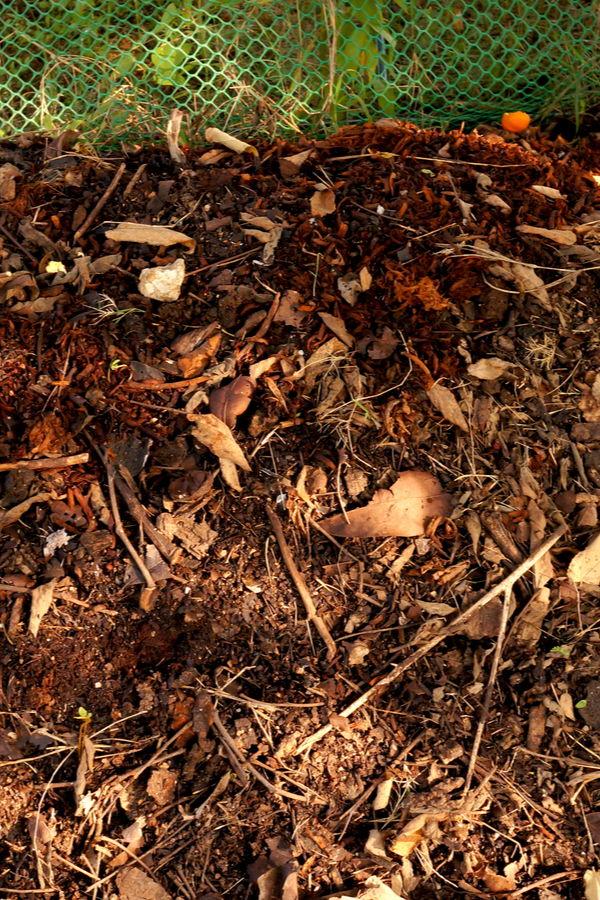
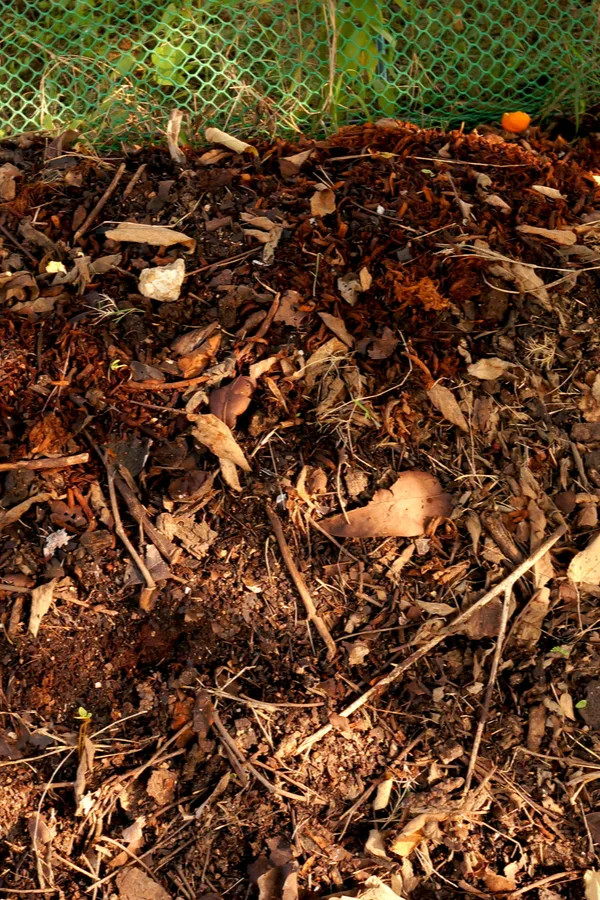
Other great leaf varieties for composting are poplar, ash, willow, cherry, black cherry and elm tree leaves. All of these are well balanced in their nutrients. They also all have lower levels of lignin.
One final note on composting the “good” leaves. Although all of these varieties have thinner membranes that break down quickly, they all benefit from being shredded before adding to the compost pile.
All leaves have a tendency to bind together when left whole. In some cases, this can slow the process of decomposition by twelve to eighteen months.
Always shred leaves before adding to a compost pile. Electric and gas shredders are great options – but a push or lawn mower can shred them incredibly well too. Product link : Earthwise Electric Chipper/Shredder
There are some varieties of trees leaves that can still be composted, but should be used only in moderation.
In some cases, it is because the leaves fall more on the acidic side and can upset the final PH makeup of a compost pile. In other cases, some trees leaves tend to have a bit higher lignin levels.
When composting the varieties below, try to keep your pile’s make-up at no more than 10 to 15% of these types of leaves:
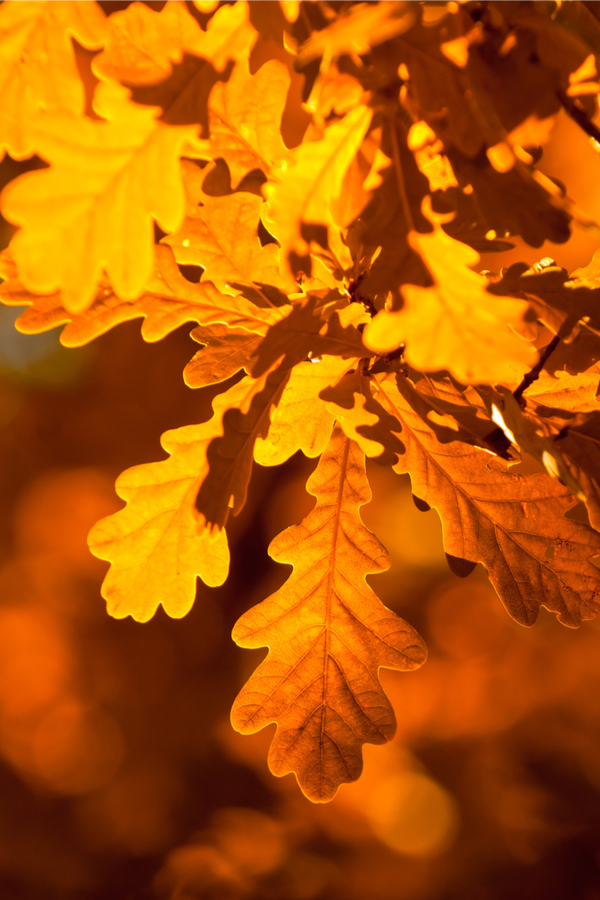
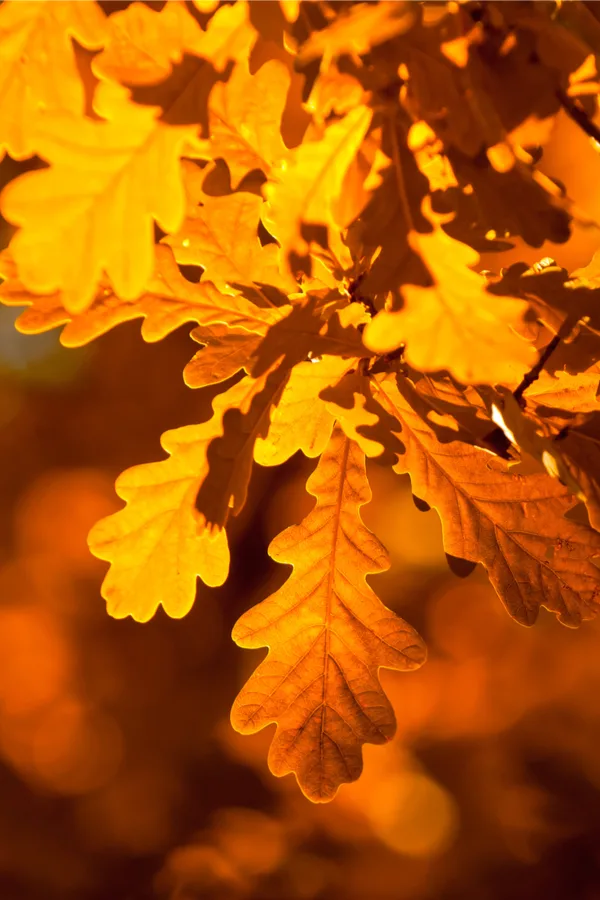
With their thick, shiny outer layer, oak leaves are extremely slow in decomposing. This is due in part to the oak leaves’ higher levels of lignin. In addition, oak leaves fall on the acidic side of the spectrum. Although they can be composted, they should be used in moderation.
Like oak trees, beech trees also have a higher level of lignin. Their waxy leaves also tend to take much longer to compost as well. It is okay to add a small portion of beech leaves to a compost pile, but they should never make up more than 10% of the total makeup.
Although the leaves of the Ginkgo tree do not contain any harmful ingredients to plants, they are extremely waxy. Because of this, they can take much longer to break down when used in large quantities.
Add them in moderation to piles, always being sure to shred them as finely as possible to speed decomposition. Unfortunately, these leaves are also hard to shred!
There are some leaves that should never be composted and never used around plants. Here are three to always avoid:
Black walnut trees and gardening simply do not go hand in hand. Not only can the roots of black walnut trees be toxic to a whole slew of annuals and perennials, their leaves can as well.
Black walnut trees excrete a toxin known as juglone. This toxin can make quick work of vegetable garden plants as well as many flowering annuals and perennials. If that wasn’t enough, the leaves of black walnut trees contain ingredients that can also prevent seeds from germinating.
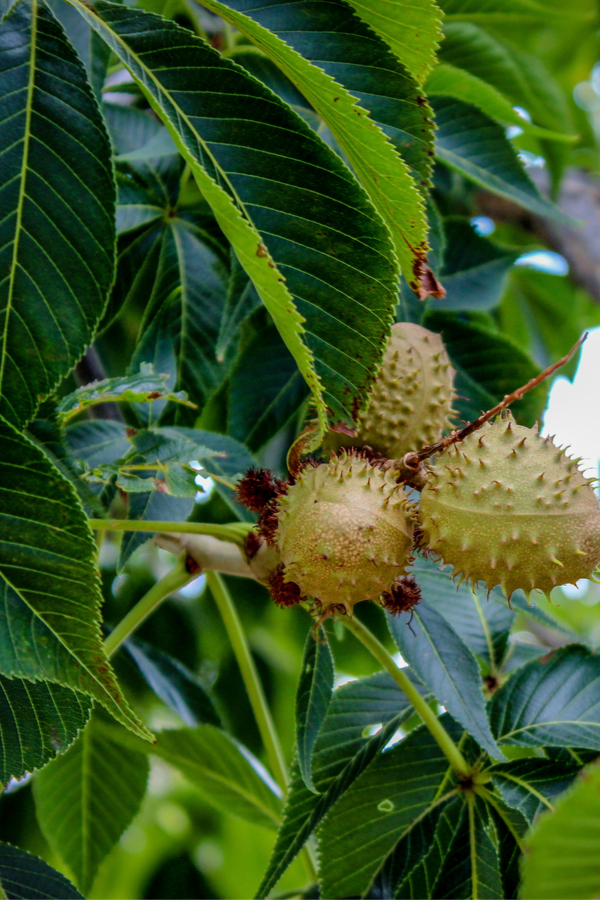
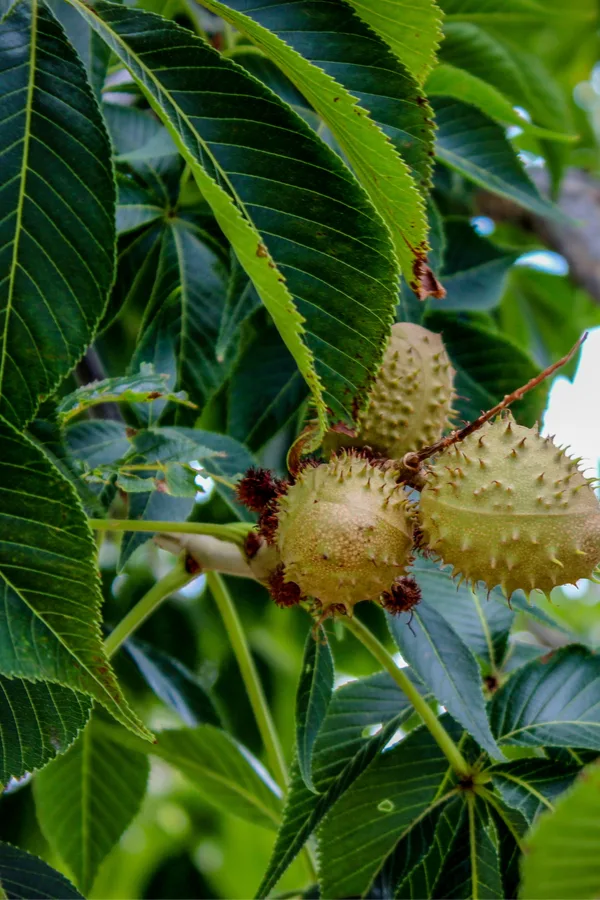
Not only are the glossy, hard leaves of the buckeye tree nearly impossible to compost, they too have a toxin that can be harmful to wildlife and humans as well. Much like with the black walnut, leave buckeye leaves out of a compost pile.
The eucalyptus tree and leaves contain a toxin that can prohibit plant growth as well as prohibiting seeds from germinating. Always keep eucalyptus leaves out of the compost pile completely to avoid any adverse issues with plants.
Here is to making the most of your autumn leaves, and to building healthy, nutrient filled compost with leaves! For more information on how to build a great fall compost pile with leaves, check out our How To Create A Great Fall Compost Pile article on the blog.
Follow Our Facebook Page For Great Gardening Tips And Advice! This Is My Garden Facebook Page
This Is My Garden is a garden website created by gardeners, for gardeners. Jim and Mary Competti have been writing gardening, DIY and recipe articles and books and speaking for over 15 years from their 46 acre Ohio farm. They publish three articles every week, 52 weeks a year. Sign up today to follow via email, or follow along!